What this means for leaders
AI adoption is becoming a portfolio and operating-model decision. The strongest moves pair platform flexibility with control, workforce readiness, and a business case that survives contact with day-to-day work.
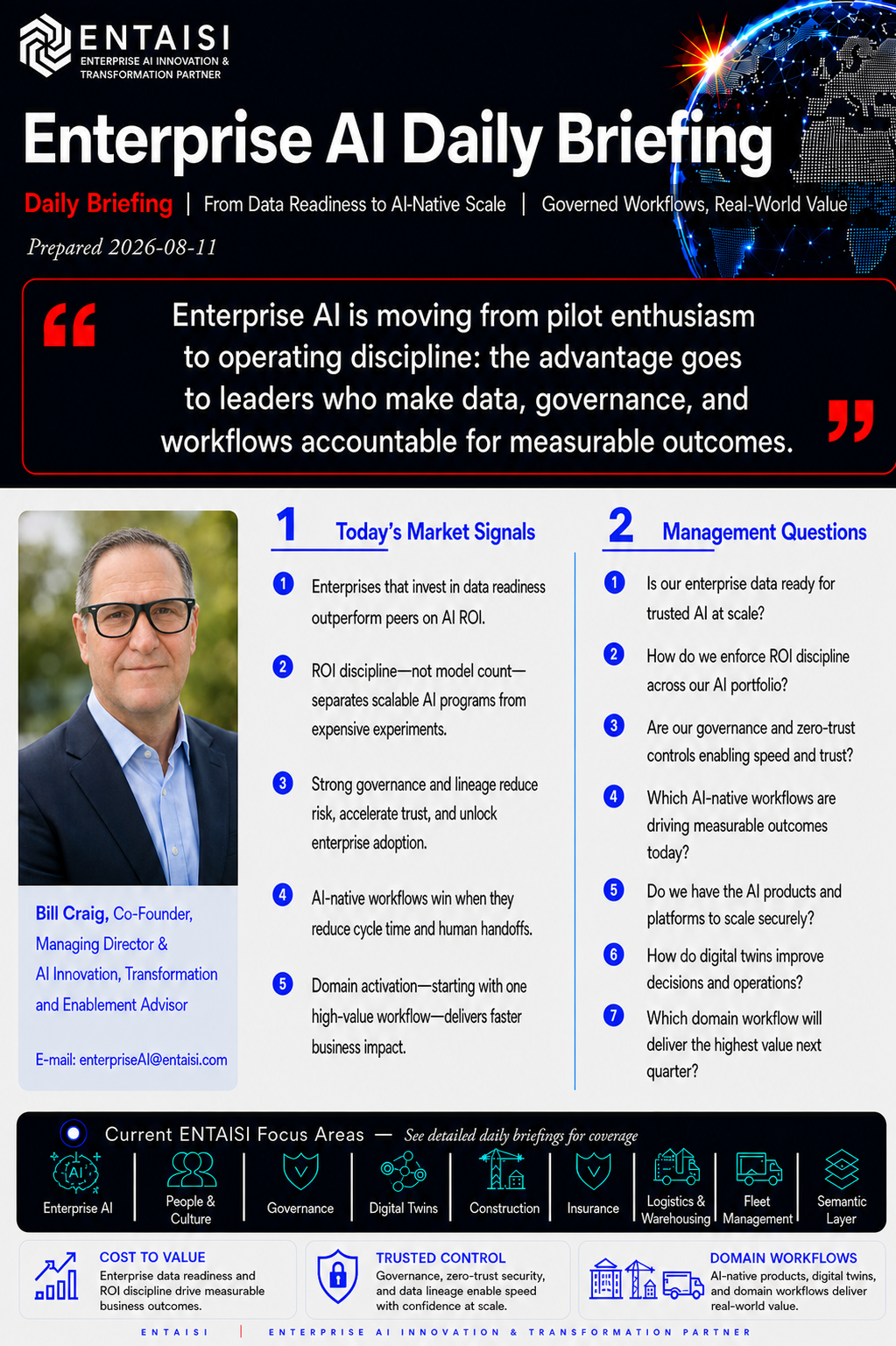
Today’s coverage follows the shift from AI experimentation to governed, measurable operating value—anchored in data readiness, lower model costs, AI-native products, leadership ownership, and domain workflows.
August 11’s briefing shows enterprise AI entering an accountability phase. The cost of models is falling and AI-native products are multiplying, but value still depends on trustworthy data, workflow ownership, integration, and evidence that a deployment improves a business metric.
Across the stories, governance is becoming an operating capability rather than a legal afterthought. Zero-trust controls, transparency rules, semantic context, and human oversight are moving closer to the execution layer, while leaders are being asked to connect finance, technology, people, and domain operators around the same outcome.
The business risk is fragmentation: cheaper experiments, disconnected agents, unprepared workforces, and pilots that never reach production can increase spend without improving performance. Leadership priority should be a small number of instrumented workflows with named owners, clear data thresholds, measurable ROI, and escalation paths for exceptions.
AI adoption is becoming a portfolio and operating-model decision. The strongest moves pair platform flexibility with control, workforce readiness, and a business case that survives contact with day-to-day work.
Choose the workflows to scale, assign accountability for data and outcomes, set governance gates before autonomy expands, and use domain pilots in construction, insurance, logistics, and fleet operations to prove value in context.
Lower prices widen the experiment funnel; they do not replace outcome measurement, adoption discipline, or CFO-level accountability.
Zero trust, transparency, semantic context, and human oversight are becoming prerequisites for reliable agentic operations.
AI-native products, digital twins, contact centers, and physical-domain systems show where measurable performance gains can emerge.
Which AI-enabled workflow will we instrument end to end this quarter, and who owns the outcome?
Are the data quality, access, semantic context, and governance thresholds strong enough for the decision we want AI to support?
Are lower model prices changing our investment portfolio, or merely increasing the number of experiments we run?
How will we monitor exceptions, human handoffs, permissions, and zero-trust controls as agents become more autonomous?
Which leadership, operating-model, and skills changes must happen before the new capability can scale?
Where can construction, insurance, logistics, or fleet operations produce the clearest evidence of value?
Which AI-native product or platform shift could change our customer experience, cost base, or competitive position?
Today’s stories cluster around the following enterprise themes, with each panel linked to its category coverage.
Data readiness, model economics, contact-center adoption, healthcare investment, mobility lessons, and the infrastructure choices behind enterprise scale.
Labs are being judged by reusable business capabilities, startup pathways, and customer-experience prototypes—not by research volume alone.
Governance, industrialization, and AI-enabled service models show how organizations are redesigning work around measurable performance.
ROI evidence, spend concentration, and the gap between insight generation and cost reduction define the value discipline leaders need next.
AIOS stories connect models, agents, devices, and enterprise data into a more coordinated operating layer.
MCP-native automation, AI-native platforms, and multi-model flexibility are compressing the path from capability to workflow execution.
Commercial packaging, healthcare investment, and customer-experience readiness reveal where adoption can become repeatable and accountable.
New AI-native companies and products are changing the assumptions behind software creation, customer value, and operating leverage.
Agentic governance, zero-trust security, and enterprise deployment patterns define the control plane for autonomous work.
Executive technology roles, architecture choices, and finance leadership are becoming the connective tissue for enterprise AI execution.
Transparency rules, regulatory uncertainty, and policy design are moving governance from principle to operating requirement.
AI capability depends on professional talent, transformation leadership, and workforce strategies that can absorb a long adoption curve.
Simulation and digital-twin research show how domain models can improve resilience, engineering decisions, and production sequencing.
Knowledge layers and semantic architecture provide the shared context agents need for more accurate enterprise decisions.
Construction signals connect AI to education, labor, union strategy, and the changing economics of physical project delivery.
Insurance developments push AI into agentic service, underwriting and care decisions, and the literacy required for responsible adoption.
Logistics stories link AI to drone networks, warehouse coordination, robotics, throughput, and network resilience.
Fleet signals focus on recalls, mixed-energy operations, jobsite intelligence, maintenance, and safety in field conditions.
Vertical coverage shows where AI becomes concrete when attached to domain context, physical operations, and accountable outcomes.
Construction stories point to the intersection of workforce, jobsite intelligence, education, and capital allocation—where AI must improve safety, productivity, and delivery confidence.
Insurance signals are moving AI into underwriting, claims, care decisions, and industry literacy, raising the importance of explainability and accountable human judgment.
Logistics coverage connects AI with warehouse coordination, robotics, drones, throughput, and network resilience across increasingly complex physical systems.
Fleet signals focus on maintenance, mixed-energy operations, safety, asset visibility, and jobsite coordination—areas where value must show up in field performance.
The category brief below preserves the three source overview paragraphs for every unique story and links each story to its exact publication.
Most enterprise AI failures start well before model selection. The “first mile” problem is the unglamorous work of making operational data trustworthy, findable, governed, and usable enough that AI systems can support real decisions.
The practical signal is that AI readiness is now an operating discipline, not a data-engineering side quest. Teams that skip lineage, ownership, metadata, access controls, and quality thresholds tend to discover the weakness later—when pilots stall, outputs cannot be trusted, or business users refuse to rely on the system.
For executives, the issue is sequencing. Investment in models, copilots, and agents should follow a hard review of the data domains that matter most to the target workflow. If the underlying records are incomplete, inconsistent, or poorly governed, AI acceleration simply moves bad information through the organization faster.
Why it matters: In Enterprise AI, Your Data is Not Ready: Solving the First Mile Gap for Enterprise AI puts the operating bottleneck in view: the value case depends on execution conditions, not on the headline technology alone.
Falling enterprise AI costs change the economics of experimentation. Price competition and stronger open-source options make it easier for companies to test more use cases, compare architectures, and negotiate with incumbent vendors.
Lower unit costs do not remove the real cost drivers. Integration, security review, data preparation, monitoring, change management, and process redesign can still dominate the budget. The risk is that cheaper inference encourages a larger portfolio of weak pilots rather than a smaller set of production-grade deployments.
The opportunity is leverage. Enterprises can use lower model costs to revisit use cases that previously failed the business case, especially where high-volume summarization, classification, search, coding, service, or document workflows were constrained by consumption pricing.
Why it matters: The signal from Enterprise AI costs hit yearly low driven by price wars, open-source models matters for Enterprise AI because it changes what leaders must measure—whether the organization can move from an attractive capability to a dependable workflow.
Fusion Connect is positioning flat-fee pricing as a way to make AI-powered contact centers easier to budget, compare, and approve.
The move speaks to a buying problem that has slowed many contact-center AI deployments: leaders may like the automation thesis but hesitate when usage-based pricing makes monthly spend hard to forecast. A fixed-fee model changes the conversation from “how much will this cost if customers actually use it?” to “can this improve the service operation enough to justify a committed spend?”
The operational test is not the invoice structure. It is whether the platform can handle real customer intents, route exceptions cleanly, preserve brand tone, and give supervisors enough visibility to intervene before quality slips. Predictable pricing may accelerate approval, but performance proof still has to come from containment, resolution quality, escalation accuracy, and customer satisfaction.
Why it matters: For Enterprise AI, this development makes accountability more concrete. Fusion Connect Simplifies Enterprise AI Adoption with Predictable Flat-Fee Pricing for AI-Powered Contact Centers is a reminder that adoption, control, and business ownership have to advance together.
Enterprise AI lessons learned from autonomous mobility - infoworld.com. The story raises a practical enterprise AI question rather than a broad technology theme.
The business issue is direct: enterprise ai lessons learned from autonomous mobility - infoworld.com. For a reader, the important signal is how this affects budget, workflow ownership, customer experience, risk, or operating capacity. The analysis should therefore stay close to the facts in the story and avoid generic AI-adoption language.
The executive question is what this changes for enterprise ai planning, investment timing, operating accountability, and measurable outcomes. A useful review should compare the current process with the proposed change and identify the evidence an executive would need before making a funding or operating decision. The takeaway should be specific enough that a business owner can act on it without translating boilerplate into a real decision.
Why it matters: Enterprise AI lessons learned from autonomous mobility gives Enterprise AI leaders a practical test: can the organization absorb the change without creating hidden cost, unmanaged risk, or a new handoff failure?
Doximity bets big on hospital adoption of enterprise AI as it ramps up tech spending - Fierce Healthcare. The story raises a practical enterprise AI question rather than a broad technology theme.
The business issue is direct: doximity bets big on hospital adoption of enterprise ai as it ramps up tech spending - fierce healthcare. For a reader, the important signal is how this affects budget, workflow ownership, customer experience, risk, or operating capacity. The analysis should therefore stay close to the facts in the story and avoid generic AI-adoption language.
The executive question is what this changes for enterprise ai planning, investment timing, operating accountability, and measurable outcomes. A useful review should compare the current process with the proposed change and identify the evidence an executive would need before making a funding or operating decision. The takeaway should be specific enough that a business owner can act on it without translating boilerplate into a real decision.
Why it matters: The business implication in Enterprise AI is broader than the product announcement. Doximity bets big on hospital adoption of enterprise AI as it ramps up tech spending points to the data, talent, governance, and process choices that determine whether the investment compounds.
The New Security Mandate: AI is Forcing a Different Answer to Your Infrastructure Question - broadcom.com. The story raises a practical enterprise AI question rather than a broad technology theme.
The business issue is direct: the new security mandate: ai is forcing a different answer to your infrastructure question - broadcom.com. For a reader, the important signal is how this affects budget, workflow ownership, customer experience, risk, or operating capacity. The analysis should therefore stay close to the facts in the story and avoid generic AI-adoption language.
The executive question is what this changes for enterprise ai planning, investment timing, operating accountability, and measurable outcomes. A useful review should compare the current process with the proposed change and identify the evidence an executive would need before making a funding or operating decision. The takeaway should be specific enough that a business owner can act on it without translating boilerplate into a real decision.
Why it matters: Read through a Enterprise AI lens, The New Security Mandate: AI is Forcing a Different Answer to Your Infrastructure Question shifts attention from experimentation to operating proof. Leaders need evidence that the workflow improves a defined outcome while exceptions remain visible.
Empowering Enterprises with AI: How Juno Labs AI Transforms Business Operations - CIOReview. Juno Labs is presented as an example of AI experimentation being packaged around business operations rather than isolated technical exploration.
The business issue is direct: empowering enterprises with ai: how juno labs ai transforms business operations - cioreview. For a reader, the important signal is how this affects budget, workflow ownership, customer experience, risk, or operating capacity. The analysis should therefore stay close to the facts in the story and avoid generic AI-adoption language.
The executive question is what this changes for enterprise ai labs planning, investment timing, operating accountability, and measurable outcomes. A useful review should compare the current process with the proposed change and identify the evidence an executive would need before making a funding or operating decision. The takeaway should be specific enough that a business owner can act on it without translating boilerplate into a real decision.
Why it matters: In Enterprise AI Labs, Empowering Enterprises with AI: How Juno Labs AI Transforms Business Operations puts the operating bottleneck in view: the value case depends on execution conditions, not on the headline technology alone.
SAP Labs India Unveils 2026 Startup Studio Cohort Focused on Enterprise AI and Deep-Tech Innovation - SAP News Center. SAP Labs India’s startup cohort shows a lab model being used to source enterprise AI and deep-tech options from outside the core product organization.
The business issue is direct: sap labs india unveils 2026 startup studio cohort focused on enterprise ai and deep-tech innovation - sap news center. For a reader, the important signal is how this affects budget, workflow ownership, customer experience, risk, or operating capacity. The analysis should therefore stay close to the facts in the story and avoid generic AI-adoption language.
The executive question is what this changes for enterprise ai labs planning, investment timing, operating accountability, and measurable outcomes. A useful review should compare the current process with the proposed change and identify the evidence an executive would need before making a funding or operating decision. The takeaway should be specific enough that a business owner can act on it without translating boilerplate into a real decision.
Why it matters: The signal from SAP Labs India Unveils 2026 Startup Studio Cohort Focused on Enterprise AI and Deep-Tech Innovation matters for Enterprise AI Labs because it changes what leaders must measure—whether the organization can move from an attractive capability to a dependable workflow.
NiCE Labs Turns Agentic AI Research Into CX Prototypes - CMSWire. NiCE Labs is pushing agentic AI research toward customer-experience prototypes, which makes the lab function more tied to near-term product experimentation.
The business issue is direct: nice labs turns agentic ai research into cx prototypes - cmswire. For a reader, the important signal is how this affects budget, workflow ownership, customer experience, risk, or operating capacity. The analysis should therefore stay close to the facts in the story and avoid generic AI-adoption language.
The executive question is what this changes for enterprise ai labs planning, investment timing, operating accountability, and measurable outcomes. A useful review should compare the current process with the proposed change and identify the evidence an executive would need before making a funding or operating decision. The takeaway should be specific enough that a business owner can act on it without translating boilerplate into a real decision.
Why it matters: For Enterprise AI Labs, this development makes accountability more concrete. NiCE Labs Turns Agentic AI Research Into CX Prototypes is a reminder that adoption, control, and business ownership have to advance together.
AI governance is becoming the foundation for enterprise-scale agentic AI - Express Computer. Dated August 10, 2026, this operating-model item is about how accountability, governance, and delivery cadence change AI execution.
The business issue is direct: ai governance is becoming the foundation for enterprise-scale agentic ai - express computer. For a reader, the important signal is how this affects budget, workflow ownership, customer experience, risk, or operating capacity. The analysis should therefore stay close to the facts in the story and avoid generic AI-adoption language.
The executive question is what this changes for ai operating models planning, investment timing, operating accountability, and measurable outcomes. A useful review should compare the current process with the proposed change and identify the evidence an executive would need before making a funding or operating decision. The takeaway should be specific enough that a business owner can act on it without translating boilerplate into a real decision.
Why it matters: In AI Operating Models, AI governance is becoming the foundation for enterprise-scale agentic AI puts the operating bottleneck in view: the value case depends on execution conditions, not on the headline technology alone.
Beyond the AI Pilot Trap: Industrializing Enterprise AI for Measurable Value - cxotoday.com. Dated August 10, 2026, this operating-model item is about how accountability, governance, and delivery cadence change AI execution.
The business issue is direct: beyond the ai pilot trap: industrializing enterprise ai for measurable value - cxotoday.com. For a reader, the important signal is how this affects budget, workflow ownership, customer experience, risk, or operating capacity. The analysis should therefore stay close to the facts in the story and avoid generic AI-adoption language.
The executive question is what this changes for ai operating models planning, investment timing, operating accountability, and measurable outcomes. A useful review should compare the current process with the proposed change and identify the evidence an executive would need before making a funding or operating decision. The takeaway should be specific enough that a business owner can act on it without translating boilerplate into a real decision.
Why it matters: The signal from Beyond the AI Pilot Trap: Industrializing Enterprise AI for Measurable Value matters for AI Operating Models because it changes what leaders must measure—whether the organization can move from an attractive capability to a dependable workflow.
iQor Reveals AI-Enabled Operating Model Behind Industry-Leading Client Performance - Yahoo Finance Singapore. Dated August 6, 2026, this operating-model item is about how accountability, governance, and delivery cadence change AI execution.
The business issue is direct: iqor reveals ai-enabled operating model behind industry-leading client performance - yahoo finance singapore. For a reader, the important signal is how this affects budget, workflow ownership, customer experience, risk, or operating capacity. The analysis should therefore stay close to the facts in the story and avoid generic AI-adoption language.
The executive question is what this changes for ai operating models planning, investment timing, operating accountability, and measurable outcomes. A useful review should compare the current process with the proposed change and identify the evidence an executive would need before making a funding or operating decision. The takeaway should be specific enough that a business owner can act on it without translating boilerplate into a real decision.
Why it matters: For AI Operating Models, this development makes accountability more concrete. iQor Reveals AI-Enabled Operating Model Behind Industry-Leading Client Performance is a reminder that adoption, control, and business ownership have to advance together.
The ROI Calculation Every Enterprise Misses When Adopting AI in Software Development - The AI Journal. Dated August 3, 2026, this ROI item focuses on whether AI spend is translating into measurable economic benefit.
The business issue is direct: the roi calculation every enterprise misses when adopting ai in software development - the ai journal. For a reader, the important signal is how this affects budget, workflow ownership, customer experience, risk, or operating capacity. The analysis should therefore stay close to the facts in the story and avoid generic AI-adoption language.
The executive question is what this changes for enterprise ai-roi & value maxing planning, investment timing, operating accountability, and measurable outcomes. A useful review should compare the current process with the proposed change and identify the evidence an executive would need before making a funding or operating decision. The takeaway should be specific enough that a business owner can act on it without translating boilerplate into a real decision.
Why it matters: In Enterprise AI-ROI & Value Maxing, The ROI Calculation Every Enterprise Misses When Adopting AI in Software Development puts the operating bottleneck in view: the value case depends on execution conditions, not on the headline technology alone.
Enterprise AI Adoption: 59% Spend $1M+, 29% See ROI [2026] - tech-insider.org. Dated July 30, 2026, this ROI item focuses on whether AI spend is translating into measurable economic benefit.
The business issue is direct: enterprise ai adoption: 59% spend $1m+, 29% see roi [2026] - tech-insider.org. For a reader, the important signal is how this affects budget, workflow ownership, customer experience, risk, or operating capacity. The analysis should therefore stay close to the facts in the story and avoid generic AI-adoption language.
The executive question is what this changes for enterprise ai-roi & value maxing planning, investment timing, operating accountability, and measurable outcomes. A useful review should compare the current process with the proposed change and identify the evidence an executive would need before making a funding or operating decision. The takeaway should be specific enough that a business owner can act on it without translating boilerplate into a real decision.
Why it matters: The signal from Enterprise AI Adoption: 59% Spend $1M+, 29% See ROI [2026] matters for Enterprise AI-ROI & Value Maxing because it changes what leaders must measure—whether the organization can move from an attractive capability to a dependable workflow.
Enterprise AI is generating business insights but not saving money, and the governance gap is widening - MarketScale. Dated July 26, 2026, this ROI item focuses on whether AI spend is translating into measurable economic benefit.
The business issue is direct: enterprise ai is generating business insights but not saving money, and the governance gap is widening - marketscale. For a reader, the important signal is how this affects budget, workflow ownership, customer experience, risk, or operating capacity. The analysis should therefore stay close to the facts in the story and avoid generic AI-adoption language.
The executive question is what this changes for enterprise ai-roi & value maxing planning, investment timing, operating accountability, and measurable outcomes. A useful review should compare the current process with the proposed change and identify the evidence an executive would need before making a funding or operating decision. The takeaway should be specific enough that a business owner can act on it without translating boilerplate into a real decision.
Why it matters: For Enterprise AI-ROI & Value Maxing, this development makes accountability more concrete. Enterprise AI is generating business insights but not saving money, and the governance gap is widening is a reminder that adoption, control, and business ownership have to advance together.
ThunderSoft (300496.SZ): In the field of AI smartphones, the company is actively exploring on-device AI operating systems (AIOS) for smartphones. - 富途牛牛. Dated July 23, 2026, this AIOS item is about orchestration, control, and the platform layer forming around enterprise AI.
The business issue is direct: thundersoft (300496.sz): in the field of ai smartphones, the company is actively exploring on-device ai operating systems (aios) for smartphones. - 富途牛牛. For a reader, the important signal is how this affects budget, workflow ownership, customer experience, risk, or operating capacity. The analysis should therefore stay close to the facts in the story and avoid generic AI-adoption language.
The executive question is what this changes for ai operating systems (aios) planning, investment timing, operating accountability, and measurable outcomes. A useful review should compare the current process with the proposed change and identify the evidence an executive would need before making a funding or operating decision. The takeaway should be specific enough that a business owner can act on it without translating boilerplate into a real decision.
Why it matters: In AI Operating Systems (AIOS), ThunderSoft ( 300496.SZ ): In the field of AI smartphones, the company is actively exploring on-device AI operating systems (AIOS) for smartphones. puts the operating bottleneck in view: the value case depends on execution conditions, not on the headline technology alone.
Alation Launches AIOS: All-New Intelligence Operating System for Enterprise AI - StorageNewsletter. Dated July 16, 2026, this AIOS item is about orchestration, control, and the platform layer forming around enterprise AI.
The business issue is direct: alation launches aios: all-new intelligence operating system for enterprise ai - storagenewsletter. For a reader, the important signal is how this affects budget, workflow ownership, customer experience, risk, or operating capacity. The analysis should therefore stay close to the facts in the story and avoid generic AI-adoption language.
The executive question is what this changes for ai operating systems (aios) planning, investment timing, operating accountability, and measurable outcomes. A useful review should compare the current process with the proposed change and identify the evidence an executive would need before making a funding or operating decision. The takeaway should be specific enough that a business owner can act on it without translating boilerplate into a real decision.
Why it matters: The signal from Alation Launches AIOS: All-New Intelligence Operating System for Enterprise AI matters for AI Operating Systems (AIOS) because it changes what leaders must measure—whether the organization can move from an attractive capability to a dependable workflow.
Alation builds AI agent operating system - Blocks & Files. Dated July 14, 2026, this AIOS item is about orchestration, control, and the platform layer forming around enterprise AI.
The business issue is direct: alation builds ai agent operating system - blocks & files. For a reader, the important signal is how this affects budget, workflow ownership, customer experience, risk, or operating capacity. The analysis should therefore stay close to the facts in the story and avoid generic AI-adoption language.
The executive question is what this changes for ai operating systems (aios) planning, investment timing, operating accountability, and measurable outcomes. A useful review should compare the current process with the proposed change and identify the evidence an executive would need before making a funding or operating decision. The takeaway should be specific enough that a business owner can act on it without translating boilerplate into a real decision.
Why it matters: For AI Operating Systems (AIOS), this development makes accountability more concrete. Alation builds AI agent operating system is a reminder that adoption, control, and business ownership have to advance together.
Lucrative AI Launches Out of Stealth with $500K in Pre-Seed Funding to Bring MCP-Native Automation to Enterprise Revenue Operations - The AI Journal. Dated August 11, 2026, this automation item is about the business handoff or workflow bottleneck named in the headline.
The business issue is direct: lucrative ai launches out of stealth with $500k in pre-seed funding to bring mcp-native automation to enterprise revenue operations - the ai journal. For a reader, the important signal is how this affects budget, workflow ownership, customer experience, risk, or operating capacity. The analysis should therefore stay close to the facts in the story and avoid generic AI-adoption language.
The executive question is what this changes for ai automation planning, investment timing, operating accountability, and measurable outcomes. A useful review should compare the current process with the proposed change and identify the evidence an executive would need before making a funding or operating decision. The takeaway should be specific enough that a business owner can act on it without translating boilerplate into a real decision.
Why it matters: In AI Automation, Lucrative AI Launches Out of Stealth with $500K in Pre-Seed Funding to Bring MCP-Native Automation to Enterprise Revenue Operations puts the operating bottleneck in view: the value case depends on execution conditions, not on the headline technology alone.
Can AI-Native Platforms Fix Fragmented Enterprise CX? - CRM Buyer. Dated August 10, 2026, this automation item is about the business handoff or workflow bottleneck named in the headline.
The business issue is direct: can ai-native platforms fix fragmented enterprise cx? - crm buyer. For a reader, the important signal is how this affects budget, workflow ownership, customer experience, risk, or operating capacity. The analysis should therefore stay close to the facts in the story and avoid generic AI-adoption language.
The executive question is what this changes for ai automation planning, investment timing, operating accountability, and measurable outcomes. A useful review should compare the current process with the proposed change and identify the evidence an executive would need before making a funding or operating decision. The takeaway should be specific enough that a business owner can act on it without translating boilerplate into a real decision.
Why it matters: The signal from Can AI-Native Platforms Fix Fragmented Enterprise CX? matters for AI Automation because it changes what leaders must measure—whether the organization can move from an attractive capability to a dependable workflow.
Oracle and Google Expand Enterprise AI: "Organisations need the flexibility to choose the AI model best suited to each problem" - EME Outlook Magazine. Dated August 10, 2026, this automation item is about the business handoff or workflow bottleneck named in the headline.
The business issue is direct: oracle and google expand enterprise ai: "organisations need the flexibility to choose the ai model best suited to each problem" - eme outlook magazine. For a reader, the important signal is how this affects budget, workflow ownership, customer experience, risk, or operating capacity. The analysis should therefore stay close to the facts in the story and avoid generic AI-adoption language.
The executive question is what this changes for ai automation planning, investment timing, operating accountability, and measurable outcomes. A useful review should compare the current process with the proposed change and identify the evidence an executive would need before making a funding or operating decision. The takeaway should be specific enough that a business owner can act on it without translating boilerplate into a real decision.
Why it matters: For AI Automation, this development makes accountability more concrete. Oracle and Google Expand Enterprise AI: "Organisations need the flexibility to choose the AI model best suited to each problem" is a reminder that adoption, control, and business ownership have to advance together.
Salesforce Says Agentforce Adoption Is Accelerating but Enterprise CX Readiness Remains in Question - CX Today. Dated August 10, 2026, this adoption item is about whether buyers, users, and operating teams are ready to absorb the change.
The business issue is direct: salesforce says agentforce adoption is accelerating but enterprise cx readiness remains in question - cx today. For a reader, the important signal is how this affects budget, workflow ownership, customer experience, risk, or operating capacity. The analysis should therefore stay close to the facts in the story and avoid generic AI-adoption language.
The executive question is what this changes for ai adoption planning, investment timing, operating accountability, and measurable outcomes. A useful review should compare the current process with the proposed change and identify the evidence an executive would need before making a funding or operating decision. The takeaway should be specific enough that a business owner can act on it without translating boilerplate into a real decision.
Why it matters: In AI adoption, Salesforce Says Agentforce Adoption Is Accelerating but Enterprise CX Readiness Remains in Question puts the operating bottleneck in view: the value case depends on execution conditions, not on the headline technology alone.
Ex-BioNTech execs launch 'AI-native' cancer company - pharmaphorum. Dated August 10, 2026, this AI-native item is about how company formation, product design, and operating assumptions are being rebuilt around AI.
The business issue is direct: ex-biontech execs launch 'ai-native' cancer company - pharmaphorum. For a reader, the important signal is how this affects budget, workflow ownership, customer experience, risk, or operating capacity. The analysis should therefore stay close to the facts in the story and avoid generic AI-adoption language.
The executive question is what this changes for ai-enabled, ai-first, and ai-native product and operating model shifts planning, investment timing, operating accountability, and measurable outcomes. A useful review should compare the current process with the proposed change and identify the evidence an executive would need before making a funding or operating decision. The takeaway should be specific enough that a business owner can act on it without translating boilerplate into a real decision.
Why it matters: In AI-enabled, AI-first, and AI-native product and operating model shifts, Ex-BioNTech execs launch 'AI-native' cancer company puts the operating bottleneck in view: the value case depends on execution conditions, not on the headline technology alone.
Inevitable AI Group Raises $6 Million Pre-Seed Round To Launch AI-Native SaaS Companies - Pulse 2.0. Dated August 9, 2026, this AI-native item is about how company formation, product design, and operating assumptions are being rebuilt around AI.
The business issue is direct: inevitable ai group raises $6 million pre-seed round to launch ai-native saas companies - pulse 2.0. For a reader, the important signal is how this affects budget, workflow ownership, customer experience, risk, or operating capacity. The analysis should therefore stay close to the facts in the story and avoid generic AI-adoption language.
The executive question is what this changes for ai-enabled, ai-first, and ai-native product and operating model shifts planning, investment timing, operating accountability, and measurable outcomes. A useful review should compare the current process with the proposed change and identify the evidence an executive would need before making a funding or operating decision. The takeaway should be specific enough that a business owner can act on it without translating boilerplate into a real decision.
Why it matters: The signal from Inevitable AI Group Raises $6 Million Pre-Seed Round To Launch AI-Native SaaS Companies matters for AI-enabled, AI-first, and AI-native product and operating model shifts because it changes what leaders must measure—whether the organization can move from an attractive capability to a dependable workflow.
Former Simplex founders raise $6 million to build dozens of AI-native software companies - calcalistech.com. Dated August 6, 2026, this AI-native item is about how company formation, product design, and operating assumptions are being rebuilt around AI.
The business issue is direct: former simplex founders raise $6 million to build dozens of ai-native software companies - calcalistech.com. For a reader, the important signal is how this affects budget, workflow ownership, customer experience, risk, or operating capacity. The analysis should therefore stay close to the facts in the story and avoid generic AI-adoption language.
The executive question is what this changes for ai-enabled, ai-first, and ai-native product and operating model shifts planning, investment timing, operating accountability, and measurable outcomes. A useful review should compare the current process with the proposed change and identify the evidence an executive would need before making a funding or operating decision. The takeaway should be specific enough that a business owner can act on it without translating boilerplate into a real decision.
Why it matters: For AI-enabled, AI-first, and AI-native product and operating model shifts, this development makes accountability more concrete. Former Simplex founders raise $6 million to build dozens of AI-native software companies is a reminder that adoption, control, and business ownership have to advance together.
Navigating Enterprise AI: Insights on Governance, Agentic AI, and Top-Line Growth - cxotoday.com. Dated August 10, 2026, this agentic AI item is about delegation, autonomy, and the control model required around AI agents.
The business issue is direct: navigating enterprise ai: insights on governance, agentic ai, and top-line growth - cxotoday.com. For a reader, the important signal is how this affects budget, workflow ownership, customer experience, risk, or operating capacity. The analysis should therefore stay close to the facts in the story and avoid generic AI-adoption language.
The executive question is what this changes for agentic ai planning, investment timing, operating accountability, and measurable outcomes. A useful review should compare the current process with the proposed change and identify the evidence an executive would need before making a funding or operating decision. The takeaway should be specific enough that a business owner can act on it without translating boilerplate into a real decision.
Why it matters: In Agentic AI, Navigating Enterprise AI: Insights on Governance, Agentic AI, and Top-Line Growth puts the operating bottleneck in view: the value case depends on execution conditions, not on the headline technology alone.
Agentic AI turning Zero Trust cybersecurity ‘on its head’ - Breaking Defense. Dated August 10, 2026, this agentic AI item is about delegation, autonomy, and the control model required around AI agents.
The business issue is direct: agentic ai turning zero trust cybersecurity ‘on its head’ - breaking defense. For a reader, the important signal is how this affects budget, workflow ownership, customer experience, risk, or operating capacity. The analysis should therefore stay close to the facts in the story and avoid generic AI-adoption language.
The executive question is what this changes for agentic ai planning, investment timing, operating accountability, and measurable outcomes. A useful review should compare the current process with the proposed change and identify the evidence an executive would need before making a funding or operating decision. The takeaway should be specific enough that a business owner can act on it without translating boilerplate into a real decision.
Why it matters: The signal from Agentic AI turning Zero Trust cybersecurity ‘on its head’ matters for Agentic AI because it changes what leaders must measure—whether the organization can move from an attractive capability to a dependable workflow.
Nutanix Puts Agentic AI into Action for Enterprises - AiThority. Dated August 10, 2026, this agentic AI item is about delegation, autonomy, and the control model required around AI agents.
The business issue is direct: nutanix puts agentic ai into action for enterprises - aithority. For a reader, the important signal is how this affects budget, workflow ownership, customer experience, risk, or operating capacity. The analysis should therefore stay close to the facts in the story and avoid generic AI-adoption language.
The executive question is what this changes for agentic ai planning, investment timing, operating accountability, and measurable outcomes. A useful review should compare the current process with the proposed change and identify the evidence an executive would need before making a funding or operating decision. The takeaway should be specific enough that a business owner can act on it without translating boilerplate into a real decision.
Why it matters: For Agentic AI, this development makes accountability more concrete. Nutanix Puts Agentic AI into Action for Enterprises is a reminder that adoption, control, and business ownership have to advance together.
Scotiabank Appoints Naveen Balakrishnan as Vice President, Technology Transformation & Organizational Enablement - hrtoday.in. Dated August 11, 2026, this architecture item is about the leadership, platform, and solution-design choices that determine whether AI scales coherently.
The business issue is direct: scotiabank appoints naveen balakrishnan as vice president, technology transformation & organizational enablement - hrtoday.in. For a reader, the important signal is how this affects budget, workflow ownership, customer experience, risk, or operating capacity. The analysis should therefore stay close to the facts in the story and avoid generic AI-adoption language.
The executive question is what this changes for ai enablement, ai solutions, and ai architecture planning, investment timing, operating accountability, and measurable outcomes. A useful review should compare the current process with the proposed change and identify the evidence an executive would need before making a funding or operating decision. The takeaway should be specific enough that a business owner can act on it without translating boilerplate into a real decision.
Why it matters: In AI Enablement, AI Solutions, and AI Architecture, Scotiabank Appoints Naveen Balakrishnan as Vice President, Technology Transformation & Organizational Enablement puts the operating bottleneck in view: the value case depends on execution conditions, not on the headline technology alone.
Blue Ridge Welcomes Adam Studdard as Chief Technology Officer to Lead Enterprise Technology and AI Strategy - webull.com. Dated August 6, 2026, this architecture item is about the leadership, platform, and solution-design choices that determine whether AI scales coherently.
The business issue is direct: blue ridge welcomes adam studdard as chief technology officer to lead enterprise technology and ai strategy - webull.com. For a reader, the important signal is how this affects budget, workflow ownership, customer experience, risk, or operating capacity. The analysis should therefore stay close to the facts in the story and avoid generic AI-adoption language.
The executive question is what this changes for ai enablement, ai solutions, and ai architecture planning, investment timing, operating accountability, and measurable outcomes. A useful review should compare the current process with the proposed change and identify the evidence an executive would need before making a funding or operating decision. The takeaway should be specific enough that a business owner can act on it without translating boilerplate into a real decision.
Why it matters: The signal from Blue Ridge Welcomes Adam Studdard as Chief Technology Officer to Lead Enterprise Technology and AI Strategy matters for AI Enablement, AI Solutions, and AI Architecture because it changes what leaders must measure—whether the organization can move from an attractive capability to a dependable workflow.
The CFO’s First 100 Days: Financial Steward to Enterprise Value Architect in the Age of AI - FTI Consulting. Dated July 31, 2026, this architecture item is about the leadership, platform, and solution-design choices that determine whether AI scales coherently.
The business issue is direct: the cfo’s first 100 days: financial steward to enterprise value architect in the age of ai - fti consulting. For a reader, the important signal is how this affects budget, workflow ownership, customer experience, risk, or operating capacity. The analysis should therefore stay close to the facts in the story and avoid generic AI-adoption language.
The executive question is what this changes for ai enablement, ai solutions, and ai architecture planning, investment timing, operating accountability, and measurable outcomes. A useful review should compare the current process with the proposed change and identify the evidence an executive would need before making a funding or operating decision. The takeaway should be specific enough that a business owner can act on it without translating boilerplate into a real decision.
Why it matters: For AI Enablement, AI Solutions, and AI Architecture, this development makes accountability more concrete. The CFO’s First 100 Days: Financial Steward to Enterprise Value Architect in the Age of AI is a reminder that adoption, control, and business ownership have to advance together.
EU, California Converge on AI Transparency Rules, Shifting Focus to Enterprise Governance - pymnts.com. Dated August 7, 2026, this governance item is about how policy pressure becomes controls, evidence, and operating responsibility.
The business issue is direct: eu, california converge on ai transparency rules, shifting focus to enterprise governance - pymnts.com. For a reader, the important signal is how this affects budget, workflow ownership, customer experience, risk, or operating capacity. The analysis should therefore stay close to the facts in the story and avoid generic AI-adoption language.
The executive question is what this changes for ai governance, policy, safety, and compliance, ai risk planning, investment timing, operating accountability, and measurable outcomes. A useful review should compare the current process with the proposed change and identify the evidence an executive would need before making a funding or operating decision. The takeaway should be specific enough that a business owner can act on it without translating boilerplate into a real decision.
Why it matters: In AI Governance, policy, safety, and compliance, AI Risk, EU, California Converge on AI Transparency Rules, Shifting Focus to Enterprise Governance puts the operating bottleneck in view: the value case depends on execution conditions, not on the headline technology alone.
Congress must pass a new federal law on AI governance - Brookings. Dated July 29, 2026, this governance item is about how policy pressure becomes controls, evidence, and operating responsibility.
The business issue is direct: congress must pass a new federal law on ai governance - brookings. For a reader, the important signal is how this affects budget, workflow ownership, customer experience, risk, or operating capacity. The analysis should therefore stay close to the facts in the story and avoid generic AI-adoption language.
The executive question is what this changes for ai governance, policy, safety, and compliance, ai risk planning, investment timing, operating accountability, and measurable outcomes. A useful review should compare the current process with the proposed change and identify the evidence an executive would need before making a funding or operating decision. The takeaway should be specific enough that a business owner can act on it without translating boilerplate into a real decision.
Why it matters: The signal from Congress must pass a new federal law on AI governance matters for AI Governance, policy, safety, and compliance, AI Risk because it changes what leaders must measure—whether the organization can move from an attractive capability to a dependable workflow.
How CIOs can navigate federal, state AI regulation uncertainty - TechTarget. Dated July 23, 2026, this governance item is about how policy pressure becomes controls, evidence, and operating responsibility.
The business issue is direct: how cios can navigate federal, state ai regulation uncertainty - techtarget. For a reader, the important signal is how this affects budget, workflow ownership, customer experience, risk, or operating capacity. The analysis should therefore stay close to the facts in the story and avoid generic AI-adoption language.
The executive question is what this changes for ai governance, policy, safety, and compliance, ai risk planning, investment timing, operating accountability, and measurable outcomes. A useful review should compare the current process with the proposed change and identify the evidence an executive would need before making a funding or operating decision. The takeaway should be specific enough that a business owner can act on it without translating boilerplate into a real decision.
Why it matters: For AI Governance, policy, safety, and compliance, AI Risk, this development makes accountability more concrete. How CIOs can navigate federal, state AI regulation uncertainty is a reminder that adoption, control, and business ownership have to advance together.
EXL Certified as a Best Firm for AI Professionals - analyticsindiamag.com. Dated July 28, 2026, this people-and-culture item is about the workforce habits, incentives, and leadership expectations needed for AI-enabled work.
The business issue is direct: exl certified as a best firm for ai professionals - analyticsindiamag.com. For a reader, the important signal is how this affects budget, workflow ownership, customer experience, risk, or operating capacity. The analysis should therefore stay close to the facts in the story and avoid generic AI-adoption language.
The executive question is what this changes for enterprise ai people and culture planning, investment timing, operating accountability, and measurable outcomes. A useful review should compare the current process with the proposed change and identify the evidence an executive would need before making a funding or operating decision. The takeaway should be specific enough that a business owner can act on it without translating boilerplate into a real decision.
Why it matters: In Enterprise AI People and Culture, EXL Certified as a Best Firm for AI Professionals puts the operating bottleneck in view: the value case depends on execution conditions, not on the headline technology alone.
Digitally transforming Microsoft: Our IT journey - Microsoft. Dated June 18, 2026, this people-and-culture item is about the workforce habits, incentives, and leadership expectations needed for AI-enabled work.
The business issue is direct: digitally transforming microsoft: our it journey - microsoft. For a reader, the important signal is how this affects budget, workflow ownership, customer experience, risk, or operating capacity. The analysis should therefore stay close to the facts in the story and avoid generic AI-adoption language.
The executive question is what this changes for enterprise ai people and culture planning, investment timing, operating accountability, and measurable outcomes. A useful review should compare the current process with the proposed change and identify the evidence an executive would need before making a funding or operating decision. The takeaway should be specific enough that a business owner can act on it without translating boilerplate into a real decision.
Why it matters: The signal from Digitally transforming Microsoft: Our IT journey matters for Enterprise AI People and Culture because it changes what leaders must measure—whether the organization can move from an attractive capability to a dependable workflow.
As AI transformation takes time, Accenture recalibrates its workforce strategy - People Matters Global. Dated June 18, 2026, this people-and-culture item is about the workforce habits, incentives, and leadership expectations needed for AI-enabled work.
The business issue is direct: as ai transformation takes time, accenture recalibrates its workforce strategy - people matters global. For a reader, the important signal is how this affects budget, workflow ownership, customer experience, risk, or operating capacity. The analysis should therefore stay close to the facts in the story and avoid generic AI-adoption language.
The executive question is what this changes for enterprise ai people and culture planning, investment timing, operating accountability, and measurable outcomes. A useful review should compare the current process with the proposed change and identify the evidence an executive would need before making a funding or operating decision. The takeaway should be specific enough that a business owner can act on it without translating boilerplate into a real decision.
Why it matters: For Enterprise AI People and Culture, this development makes accountability more concrete. As AI transformation takes time, Accenture recalibrates its workforce strategy is a reminder that adoption, control, and business ownership have to advance together.
Seoul National University Applies VABS Simulation for Air Mobility, Digital Twin Projects - CompositesWorld. Dated August 10, 2026, this digital-twin item is about whether simulation can influence production, resilience, or engineering decisions.
The business issue is direct: seoul national university applies vabs simulation for air mobility, digital twin projects - compositesworld. For a reader, the important signal is how this affects budget, workflow ownership, customer experience, risk, or operating capacity. The analysis should therefore stay close to the facts in the story and avoid generic AI-adoption language.
The executive question is what this changes for digital twins and industrial simulation planning, investment timing, operating accountability, and measurable outcomes. A useful review should compare the current process with the proposed change and identify the evidence an executive would need before making a funding or operating decision. The takeaway should be specific enough that a business owner can act on it without translating boilerplate into a real decision.
Why it matters: In Digital twins and industrial simulation, Seoul National University Applies VABS Simulation for Air Mobility, Digital Twin Projects puts the operating bottleneck in view: the value case depends on execution conditions, not on the headline technology alone.
A multi-layer digital twin framework for enhanced production resilience in railcar manufacturing - Springer Nature Link. Dated August 8, 2026, this digital-twin item is about whether simulation can influence production, resilience, or engineering decisions.
The business issue is direct: a multi-layer digital twin framework for enhanced production resilience in railcar manufacturing - springer nature link. For a reader, the important signal is how this affects budget, workflow ownership, customer experience, risk, or operating capacity. The analysis should therefore stay close to the facts in the story and avoid generic AI-adoption language.
The executive question is what this changes for digital twins and industrial simulation planning, investment timing, operating accountability, and measurable outcomes. A useful review should compare the current process with the proposed change and identify the evidence an executive would need before making a funding or operating decision. The takeaway should be specific enough that a business owner can act on it without translating boilerplate into a real decision.
Why it matters: The signal from A multi-layer digital twin framework for enhanced production resilience in railcar manufacturing matters for Digital twins and industrial simulation because it changes what leaders must measure—whether the organization can move from an attractive capability to a dependable workflow.
Digital Twins in Manufacturing: Why Sequence Matters More Than Technology - idc.com. Dated August 6, 2026, this digital-twin item is about whether simulation can influence production, resilience, or engineering decisions.
The business issue is direct: digital twins in manufacturing: why sequence matters more than technology - idc.com. For a reader, the important signal is how this affects budget, workflow ownership, customer experience, risk, or operating capacity. The analysis should therefore stay close to the facts in the story and avoid generic AI-adoption language.
The executive question is what this changes for digital twins and industrial simulation planning, investment timing, operating accountability, and measurable outcomes. A useful review should compare the current process with the proposed change and identify the evidence an executive would need before making a funding or operating decision. The takeaway should be specific enough that a business owner can act on it without translating boilerplate into a real decision.
Why it matters: For Digital twins and industrial simulation, this development makes accountability more concrete. Digital Twins in Manufacturing: Why Sequence Matters More Than Technology is a reminder that adoption, control, and business ownership have to advance together.
The knowledge layer for enterprise AI - Neo4j. Dated July 20, 2026, this semantic-layer item is about how enterprises encode meaning, relationships, and context for reliable AI use.
The business issue is direct: the knowledge layer for enterprise ai - neo4j. For a reader, the important signal is how this affects budget, workflow ownership, customer experience, risk, or operating capacity. The analysis should therefore stay close to the facts in the story and avoid generic AI-adoption language.
The executive question is what this changes for ontology, knowledge graph, and semantic layer developments planning, investment timing, operating accountability, and measurable outcomes. A useful review should compare the current process with the proposed change and identify the evidence an executive would need before making a funding or operating decision. The takeaway should be specific enough that a business owner can act on it without translating boilerplate into a real decision.
Why it matters: In Ontology, knowledge graph, and semantic layer developments, The knowledge layer for enterprise AI puts the operating bottleneck in view: the value case depends on execution conditions, not on the headline technology alone.
Build a semantic layer for agentic AI on AWS with Stardog and Amazon Bedrock AgentCore | Artificial Intelligence - Amazon Web Services (AWS). Dated July 10, 2026, this semantic-layer item is about how enterprises encode meaning, relationships, and context for reliable AI use.
The business issue is direct: build a semantic layer for agentic ai on aws with stardog and amazon bedrock agentcore | artificial intelligence - amazon web services (aws). For a reader, the important signal is how this affects budget, workflow ownership, customer experience, risk, or operating capacity. The analysis should therefore stay close to the facts in the story and avoid generic AI-adoption language.
The executive question is what this changes for ontology, knowledge graph, and semantic layer developments planning, investment timing, operating accountability, and measurable outcomes. A useful review should compare the current process with the proposed change and identify the evidence an executive would need before making a funding or operating decision. The takeaway should be specific enough that a business owner can act on it without translating boilerplate into a real decision.
Why it matters: The signal from Build a semantic layer for agentic AI on AWS with Stardog and Amazon Bedrock AgentCore | Artificial Intelligence matters for Ontology, knowledge graph, and semantic layer developments because it changes what leaders must measure—whether the organization can move from an attractive capability to a dependable workflow.
Zenia Graph: Turning Data Noise into Business Clarity with Semantic Intelligence - CIOReview. Dated June 24, 2026, this semantic-layer item is about how enterprises encode meaning, relationships, and context for reliable AI use.
The business issue is direct: zenia graph: turning data noise into business clarity with semantic intelligence - cioreview. For a reader, the important signal is how this affects budget, workflow ownership, customer experience, risk, or operating capacity. The analysis should therefore stay close to the facts in the story and avoid generic AI-adoption language.
The executive question is what this changes for ontology, knowledge graph, and semantic layer developments planning, investment timing, operating accountability, and measurable outcomes. A useful review should compare the current process with the proposed change and identify the evidence an executive would need before making a funding or operating decision. The takeaway should be specific enough that a business owner can act on it without translating boilerplate into a real decision.
Why it matters: For Ontology, knowledge graph, and semantic layer developments, this development makes accountability more concrete. Zenia Graph: Turning Data Noise into Business Clarity with Semantic Intelligence is a reminder that adoption, control, and business ownership have to advance together.
Rui Liu earns $750K NSF award to advance AI in construction education - UF College of Design, Construction and Planning. Dated August 10, 2026, this construction item is about translating AI into field execution, labor planning, safety, or project delivery.
The business issue is direct: rui liu earns $750k nsf award to advance ai in construction education - uf college of design, construction and planning. For a reader, the important signal is how this affects budget, workflow ownership, customer experience, risk, or operating capacity. The analysis should therefore stay close to the facts in the story and avoid generic AI-adoption language.
The executive question is what this changes for ai in construction planning, investment timing, operating accountability, and measurable outcomes. A useful review should compare the current process with the proposed change and identify the evidence an executive would need before making a funding or operating decision. The takeaway should be specific enough that a business owner can act on it without translating boilerplate into a real decision.
Why it matters: In AI in Construction, Rui Liu earns $750K NSF award to advance AI in construction education puts the operating bottleneck in view: the value case depends on execution conditions, not on the headline technology alone.
BlackRock Signs Deal With Labor Unions for AI Construction Jobs - Bloomberg.com. Dated August 10, 2026, this construction item is about translating AI into field execution, labor planning, safety, or project delivery.
The business issue is direct: blackrock signs deal with labor unions for ai construction jobs - bloomberg.com. For a reader, the important signal is how this affects budget, workflow ownership, customer experience, risk, or operating capacity. The analysis should therefore stay close to the facts in the story and avoid generic AI-adoption language.
The executive question is what this changes for ai in construction planning, investment timing, operating accountability, and measurable outcomes. A useful review should compare the current process with the proposed change and identify the evidence an executive would need before making a funding or operating decision. The takeaway should be specific enough that a business owner can act on it without translating boilerplate into a real decision.
Why it matters: The signal from BlackRock Signs Deal With Labor Unions for AI Construction Jobs matters for AI in Construction because it changes what leaders must measure—whether the organization can move from an attractive capability to a dependable workflow.
Roundup: AI construction jobs / Jalapeño recall / US battery production - Baton Rouge Business Report. Dated August 10, 2026, this construction item is about translating AI into field execution, labor planning, safety, or project delivery.
The business issue is direct: roundup: ai construction jobs / jalapeño recall / us battery production - baton rouge business report. For a reader, the important signal is how this affects budget, workflow ownership, customer experience, risk, or operating capacity. The analysis should therefore stay close to the facts in the story and avoid generic AI-adoption language.
The executive question is what this changes for ai in construction planning, investment timing, operating accountability, and measurable outcomes. A useful review should compare the current process with the proposed change and identify the evidence an executive would need before making a funding or operating decision. The takeaway should be specific enough that a business owner can act on it without translating boilerplate into a real decision.
Why it matters: For AI in Construction, this development makes accountability more concrete. Roundup: AI construction jobs / Jalapeño recall / US battery production is a reminder that adoption, control, and business ownership have to advance together.
NTT DATA AI unveils AI-native agentic solution for the insurance industry - FutureCIO. Dated August 11, 2026, this insurance item is about how AI enters claims, underwriting, care decisions, or industry capability-building.
The business issue is direct: ntt data ai unveils ai-native agentic solution for the insurance industry - futurecio. For a reader, the important signal is how this affects budget, workflow ownership, customer experience, risk, or operating capacity. The analysis should therefore stay close to the facts in the story and avoid generic AI-adoption language.
The executive question is what this changes for ai in insurance planning, investment timing, operating accountability, and measurable outcomes. A useful review should compare the current process with the proposed change and identify the evidence an executive would need before making a funding or operating decision. The takeaway should be specific enough that a business owner can act on it without translating boilerplate into a real decision.
Why it matters: In AI in Insurance, NTT DATA AI unveils AI-native agentic solution for the insurance industry puts the operating bottleneck in view: the value case depends on execution conditions, not on the headline technology alone.
The Institutes’ Carmichael: New AIAI Designation Advances AI Literacy Across the Insurance Industry - AM Best. Dated August 10, 2026, this insurance item is about how AI enters claims, underwriting, care decisions, or industry capability-building.
The business issue is direct: the institutes’ carmichael: new aiai designation advances ai literacy across the insurance industry - am best. For a reader, the important signal is how this affects budget, workflow ownership, customer experience, risk, or operating capacity. The analysis should therefore stay close to the facts in the story and avoid generic AI-adoption language.
The executive question is what this changes for ai in insurance planning, investment timing, operating accountability, and measurable outcomes. A useful review should compare the current process with the proposed change and identify the evidence an executive would need before making a funding or operating decision. The takeaway should be specific enough that a business owner can act on it without translating boilerplate into a real decision.
Why it matters: The signal from The Institutes’ Carmichael: New AIAI Designation Advances AI Literacy Across the Insurance Industry matters for AI in Insurance because it changes what leaders must measure—whether the organization can move from an attractive capability to a dependable workflow.
Insurers Move AI Upstream Into the Care Decision - pymnts.com. Dated August 10, 2026, this insurance item is about how AI enters claims, underwriting, care decisions, or industry capability-building.
The business issue is direct: insurers move ai upstream into the care decision - pymnts.com. For a reader, the important signal is how this affects budget, workflow ownership, customer experience, risk, or operating capacity. The analysis should therefore stay close to the facts in the story and avoid generic AI-adoption language.
The executive question is what this changes for ai in insurance planning, investment timing, operating accountability, and measurable outcomes. A useful review should compare the current process with the proposed change and identify the evidence an executive would need before making a funding or operating decision. The takeaway should be specific enough that a business owner can act on it without translating boilerplate into a real decision.
Why it matters: For AI in Insurance, this development makes accountability more concrete. Insurers Move AI Upstream Into the Care Decision is a reminder that adoption, control, and business ownership have to advance together.
AI acquisitions, drone networks, and a warehouse construction surge are reshaping North American logistics in 2026 - MarketScale. Dated August 7, 2026, this logistics item is about throughput, automation, network resilience, and warehouse coordination.
The business issue is direct: ai acquisitions, drone networks, and a warehouse construction surge are reshaping north american logistics in 2026 - marketscale. For a reader, the important signal is how this affects budget, workflow ownership, customer experience, risk, or operating capacity. The analysis should therefore stay close to the facts in the story and avoid generic AI-adoption language.
The executive question is what this changes for ai in logistics & warehousing planning, investment timing, operating accountability, and measurable outcomes. A useful review should compare the current process with the proposed change and identify the evidence an executive would need before making a funding or operating decision. The takeaway should be specific enough that a business owner can act on it without translating boilerplate into a real decision.
Why it matters: In AI in Logistics & Warehousing, AI acquisitions, drone networks, and a warehouse construction surge are reshaping North American logistics in 2026 puts the operating bottleneck in view: the value case depends on execution conditions, not on the headline technology alone.
Of robots and men: Europe’s AI solutions aim to overhaul e-commerce - Euronews.com. Dated August 5, 2026, this logistics item is about throughput, automation, network resilience, and warehouse coordination.
The business issue is direct: of robots and men: europe’s ai solutions aim to overhaul e-commerce - euronews.com. For a reader, the important signal is how this affects budget, workflow ownership, customer experience, risk, or operating capacity. The analysis should therefore stay close to the facts in the story and avoid generic AI-adoption language.
The executive question is what this changes for ai in logistics & warehousing planning, investment timing, operating accountability, and measurable outcomes. A useful review should compare the current process with the proposed change and identify the evidence an executive would need before making a funding or operating decision. The takeaway should be specific enough that a business owner can act on it without translating boilerplate into a real decision.
Why it matters: The signal from Of robots and men: Europe’s AI solutions aim to overhaul e-commerce matters for AI in Logistics & Warehousing because it changes what leaders must measure—whether the organization can move from an attractive capability to a dependable workflow.
Yusen Logistics deploys Destro AI warehouse coordination platform - Robotics & Automation News. Dated August 4, 2026, this logistics item is about throughput, automation, network resilience, and warehouse coordination.
The business issue is direct: yusen logistics deploys destro ai warehouse coordination platform - robotics & automation news. For a reader, the important signal is how this affects budget, workflow ownership, customer experience, risk, or operating capacity. The analysis should therefore stay close to the facts in the story and avoid generic AI-adoption language.
The executive question is what this changes for ai in logistics & warehousing planning, investment timing, operating accountability, and measurable outcomes. A useful review should compare the current process with the proposed change and identify the evidence an executive would need before making a funding or operating decision. The takeaway should be specific enough that a business owner can act on it without translating boilerplate into a real decision.
Why it matters: For AI in Logistics & Warehousing, this development makes accountability more concrete. Yusen Logistics deploys Destro AI warehouse coordination platform is a reminder that adoption, control, and business ownership have to advance together.
From a Major Ram Recall to Hands-On AI | AF News Recap - Automotive Fleet. Dated August 10, 2026, this fleet item is about maintenance, energy use, safety, asset visibility, or jobsite coordination.
The business issue is direct: from a major ram recall to hands-on ai | af news recap - automotive fleet. For a reader, the important signal is how this affects budget, workflow ownership, customer experience, risk, or operating capacity. The analysis should therefore stay close to the facts in the story and avoid generic AI-adoption language.
The executive question is what this changes for ai in fleet management planning, investment timing, operating accountability, and measurable outcomes. A useful review should compare the current process with the proposed change and identify the evidence an executive would need before making a funding or operating decision. The takeaway should be specific enough that a business owner can act on it without translating boilerplate into a real decision.
Why it matters: In AI in Fleet Management, From a Major Ram Recall to Hands-On AI | AF News Recap puts the operating bottleneck in view: the value case depends on execution conditions, not on the headline technology alone.
00:40 Teletrac Navman Launches Energy Hub for Mixed-Energy Fleets - Commercial Carrier Journal. Dated August 10, 2026, this fleet item is about maintenance, energy use, safety, asset visibility, or jobsite coordination.
The business issue is direct: 00:40 teletrac navman launches energy hub for mixed-energy fleets - commercial carrier journal. For a reader, the important signal is how this affects budget, workflow ownership, customer experience, risk, or operating capacity. The analysis should therefore stay close to the facts in the story and avoid generic AI-adoption language.
The executive question is what this changes for ai in fleet management planning, investment timing, operating accountability, and measurable outcomes. A useful review should compare the current process with the proposed change and identify the evidence an executive would need before making a funding or operating decision. The takeaway should be specific enough that a business owner can act on it without translating boilerplate into a real decision.
Why it matters: The signal from Teletrac Navman Launches Energy Hub for Mixed-Energy Fleets matters for AI in Fleet Management because it changes what leaders must measure—whether the organization can move from an attractive capability to a dependable workflow.
CLUE Brings AI to the Jobsite with New Fleet Intelligence Suite - The National Law Review. Dated August 8, 2026, this fleet item is about maintenance, energy use, safety, asset visibility, or jobsite coordination.
The business issue is direct: clue brings ai to the jobsite with new fleet intelligence suite - the national law review. For a reader, the important signal is how this affects budget, workflow ownership, customer experience, risk, or operating capacity. The analysis should therefore stay close to the facts in the story and avoid generic AI-adoption language.
The executive question is what this changes for ai in fleet management planning, investment timing, operating accountability, and measurable outcomes. A useful review should compare the current process with the proposed change and identify the evidence an executive would need before making a funding or operating decision. The takeaway should be specific enough that a business owner can act on it without translating boilerplate into a real decision.
Why it matters: For AI in Fleet Management, this development makes accountability more concrete. CLUE Brings AI to the Jobsite with New Fleet Intelligence Suite is a reminder that adoption, control, and business ownership have to advance together.
Enterprise AI is moving into a value-and-control phase. The organizations best positioned to benefit will connect data readiness, governance, workforce design, and domain execution to a small number of measurable workflows—then scale what proves itself.