Context becomes a production dependency
Task-aware compression, semantic layers, and enterprise knowledge structures are becoming the connective tissue agents need to act with relevance and permission.
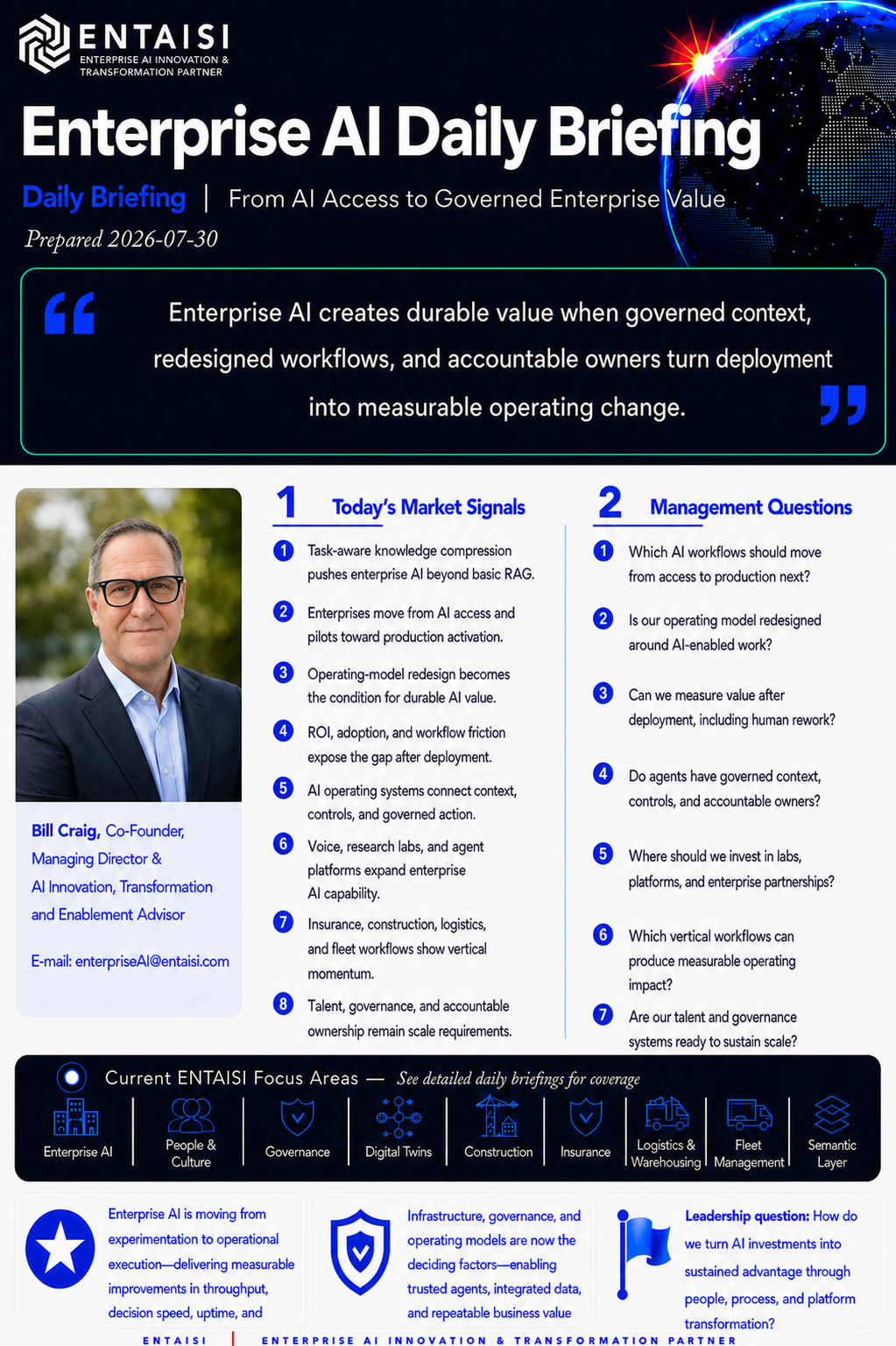
Today’s scan shows enterprise AI moving from access and experimentation toward governed operating environments. Task-aware context, AI operating systems, workflow redesign, measurable ROI, and accountable ownership are converging as the conditions for durable value. Vertical coverage makes the shift concrete across construction, insurance, logistics, and fleet operations.
Across today’s coverage, the central question is no longer whether enterprises can access AI. It is whether context, controls, redesigned workflows, skills, and ownership are strong enough to convert deployment into measurable operating change.
Task-aware compression, semantic layers, and enterprise knowledge structures are becoming the connective tissue agents need to act with relevance and permission.
Adoption and production ratios can rise while human editing, workflow friction, and weak operating models continue to dilute ROI.
Insurance, construction, logistics, and fleet use cases show whether AI is improving accountable work rather than simply increasing access to tools.
Enterprise AI coverage spans task-aware knowledge compression, Meta’s broader enterprise opportunity, production activation, and the workflow friction that remains after deployment.
Research labs and strategic partnerships are extending enterprise capability through applied research, voice innovation, and pathways from experimentation to usable products.
Today’s operating-model stories argue that AI value depends on redesigning decision rights, workflows, roles, and accountability—not simply adding another model.
ROI coverage focuses on turning AI deployment into measurable value by connecting adoption, operating economics, workflow outcomes, and human rework.
AIOS stories frame the operating system as the layer that coordinates agents, enterprise context, controls, and repeatable execution.
Automation coverage shows AI moving into practical enterprise workflows, where orchestration, process integration, and reliable handoffs determine the business result.
Adoption signals emphasize the move from broad access to activation, with production scale depending on readiness, enablement, and the surrounding operating system.
AI-native product stories show companies rebuilding revenue, customer, and operating workflows around AI rather than adding AI as a thin feature layer.
Agentic AI coverage highlights the need for governed context, dependable orchestration, observability, and accountable owners as agents move toward production.
Enablement and architecture stories connect enterprise-scale adoption to solution design, platform choices, semantic context, controls, and implementation discipline.
Governance coverage makes risk operational: policy, safety, compliance, procurement, liability, and human accountability must follow AI into production.
People and culture coverage shows that skills, role redesign, leadership behavior, and organizational readiness are prerequisites for sustained enterprise adoption.
Digital-twin coverage connects AI to engineering and industrial simulation, where faster validation and higher-fidelity models can change design and operations.
Semantic-layer stories reinforce that agents need durable enterprise meaning, relationships, and permission-aware context to act reliably.
Construction stories connect AI to forecasting, research investment, project discovery, and jobsite decisions where field data and accountability shape value.
Insurance coverage spans AI-related risk transfer and coverage decisions, showing how liability, underwriting, and governance are evolving together.
Logistics stories show warehouse automation and supply-chain platforms moving toward more intelligent, integrated material-flow operations.
Fleet-management coverage extends the word fleet into operational infrastructure and vehicle workflows, with AI aimed at faster fixes, assistance, and governed action.
Construction coverage spans AI-powered research investment and project discovery, pointing to a vertical where forecasting, opportunity identification, and field execution can become connected workflows.
AI-related insurance products and coverage decisions show a vertical working through liability, risk transfer, and governance as AI enters consequential decisions.
Warehouse automation and Dynamics 365 warehouse operations point toward more intelligent material flows, integrated platforms, and measurable supply-chain performance.
Today’s fleet coverage spans AI-assisted security-fix management and operational fleet assistance, highlighting the need to connect AI action to controlled infrastructure workflows.
Industrial simulation and digital-twin coverage shows how semantic context and AI-enhanced modeling can accelerate engineering validation and operations.
People coverage emphasizes operating-model redesign, skills, and workforce readiness as the human infrastructure needed to turn AI access into durable adoption.
Title / Headline: Beyond RAG: Task-aware knowledge compression for enterprise AI on AWS
Source: Amazon Web Services (AWS)
Publication date: July 27, 2026
Topic / Section: Enterprise AI
Beyond RAG: Task-aware knowledge compression for enterprise AI on AWS was reported in the current monitoring window. The available RSS description identifies the development and its enterprise context: Beyond RAG: Task-aware knowledge compression for enterprise AI on AWS \| Artificial Intelligence Amazon Web Services (AWS).
Implementation context: the item points to a concrete product, organizational, regulatory, or market move rather than a general AI forecast. Buyers should validate the specific capabilities, deployment assumptions, and evidence behind the announcement before treating it as a production reference.
Market linkage: this development sits within the broader enterprise ai shift from isolated pilots toward repeatable enterprise adoption, with data readiness, workflow integration, governance, and operating economics determining whether the promise becomes durable value.
“Beyond RAG: Task-aware knowledge compression for enterprise AI on AWS” matters in the Enterprise AI section because it signals the change described above—Beyond RAG: Task-aware knowledge compression for enterprise AI on AWS \| Artificial Intelligence Amazon Web Services (AWS). For adopters, the practical consequence is to use this specific move as a decision point for evaluating architecture, controls, budget, workforce readiness, or measurable operational outcomes rather than adding another disconnected AI experiment.
Source-grounded details:
Title / Headline: Zuckerberg says Meta’s enterprise AI opportunity extends beyond agents
Source: TechCrunch
Publication date: July 29, 2026
Topic / Section: Enterprise AI
Zuckerberg says Meta’s enterprise AI opportunity extends beyond agents was reported in the current monitoring window. The available RSS description identifies the development and its enterprise context: Zuckerberg says Meta’s enterprise AI opportunity extends beyond agents TechCrunch.
Implementation context: the item points to a concrete product, organizational, regulatory, or market move rather than a general AI forecast. Buyers should validate the specific capabilities, deployment assumptions, and evidence behind the announcement before treating it as a production reference.
Market linkage: this development sits within the broader enterprise ai shift from isolated pilots toward repeatable enterprise adoption, with data readiness, workflow integration, governance, and operating economics determining whether the promise becomes durable value.
“Zuckerberg says Meta’s enterprise AI opportunity extends beyond agents” matters in the Enterprise AI section because it signals the change described above—Zuckerberg says Meta’s enterprise AI opportunity extends beyond agents TechCrunch. For adopters, the practical consequence is to use this specific move as a decision point for evaluating architecture, controls, budget, workforce readiness, or measurable operational outcomes rather than adding another disconnected AI experiment.
Source-grounded details:
Title / Headline: The State of AI in the Enterprise
Source: Deloitte
Publication date: 2026
Topic / Section: Enterprise AI
The State of AI in the Enterprise was surfaced in the current monitoring window. Deloitte frames the 2026 report around the “untapped edge” of AI’s potential, arguing that organizations need to move from ambition to activation. The available source description highlights expanding worker access to AI, growth in production deployments, and expectations that the number of companies with at least 40% of AI projects in production will double within six months.
Implementation context: the item points to a current enterprise adoption benchmark rather than a single product launch. Buyers should use it to test whether their AI portfolio is moving from broad access and experimentation toward repeatable production deployment, governed scaling, and measurable operating impact.
Market linkage: this development sits within the broader enterprise ai shift from isolated pilots toward repeatable enterprise adoption, with data readiness, workflow integration, governance, and operating economics determining whether the promise becomes durable value.
“The State of AI in the Enterprise” matters in the Enterprise AI section because it provides a market-wide benchmark for whether enterprises are actually crossing from AI access into scaled production. For adopters, the practical consequence is to compare internal project mix, production ratios, and value-realization cadence against external evidence rather than relying on activity metrics or tool rollout counts.
Source-grounded details:
Title / Headline: Yesterday’s Marketing Technology & AI News
Source: The Agile Brand Guide
Publication date: July 29, 2026
Topic / Section: Enterprise AI
Yesterday’s Marketing Technology & AI News was reported in the current monitoring window. The available source description points to enterprise marketing leaders already deploying AI in production while still facing workflow friction: 70% had deployed AI in production, 88% said AI output still requires moderate to substantial human editing, and missed campaign launch dates were tied to approvals, creative production, and cross-team coordination.
Implementation context: the item points to enterprise AI’s operating bottleneck after generation. Buyers should validate where AI-generated output actually enters approval flows, brand review, creative operations, and campaign execution before treating production deployment as proof of productivity improvement.
Market linkage: this development sits within the broader enterprise ai shift from isolated pilots toward repeatable enterprise adoption, with data readiness, workflow integration, governance, and operating economics determining whether the promise becomes durable value.
“Yesterday’s Marketing Technology & AI News” matters in the Enterprise AI section because it shows that production AI adoption can still leave the surrounding business process unchanged. For adopters, the practical consequence is to measure downstream cycle time, review load, coordination costs, and human rework—not just whether AI is technically deployed.
Source-grounded details:
Title / Headline: NVIDIA and KAIST Launch Joint AI Research Lab to Accelerate AI Innovation in Korea
Source: NVIDIA Newsroom
Publication date: July 23, 2026
Topic / Section: Enterprise AI Labs
NVIDIA and KAIST Launch Joint AI Research Lab to Accelerate AI Innovation in Korea was reported in the current monitoring window. The available RSS description identifies the development and its enterprise context: NVIDIA and KAIST Launch Joint AI Research Lab to Accelerate AI Innovation in Korea NVIDIA Newsroom.
Implementation context: the item points to a concrete product, organizational, regulatory, or market move rather than a general AI forecast. Buyers should validate the specific capabilities, deployment assumptions, and evidence behind the announcement before treating it as a production reference.
Market linkage: this development sits within the broader enterprise ai labs shift from isolated pilots toward repeatable enterprise adoption, with data readiness, workflow integration, governance, and operating economics determining whether the promise becomes durable value.
“NVIDIA and KAIST Launch Joint AI Research Lab to Accelerate AI Innovation in Korea” matters in the Enterprise AI Labs section because it signals the change described above—NVIDIA and KAIST Launch Joint AI Research Lab to Accelerate AI Innovation in Korea NVIDIA Newsroom. For adopters, the practical consequence is to use this specific move as a decision point for evaluating architecture, controls, budget, workforce readiness, or measurable operational outcomes rather than adding another disconnected AI experiment.
Source-grounded details:
Title / Headline: DXC and ElevenLabs Announce Strategic Partnership to Scale Enterprise AI and Voice Innovation
Source: PR Newswire
Publication date: July 28, 2026
Topic / Section: Enterprise AI Labs
DXC and ElevenLabs Announce Strategic Partnership to Scale Enterprise AI and Voice Innovation was reported in the current monitoring window. The available RSS description identifies the development and its enterprise context: DXC and ElevenLabs Announce Strategic Partnership to Scale Enterprise AI and Voice Innovation PR Newswire.
Implementation context: the item points to a concrete product, organizational, regulatory, or market move rather than a general AI forecast. Buyers should validate the specific capabilities, deployment assumptions, and evidence behind the announcement before treating it as a production reference.
Market linkage: this development sits within the broader enterprise ai labs shift from isolated pilots toward repeatable enterprise adoption, with data readiness, workflow integration, governance, and operating economics determining whether the promise becomes durable value.
“DXC and ElevenLabs Announce Strategic Partnership to Scale Enterprise AI and Voice Innovation” matters in the Enterprise AI Labs section because it signals the change described above—DXC and ElevenLabs Announce Strategic Partnership to Scale Enterprise AI and Voice Innovation PR Newswire. For adopters, the practical consequence is to use this specific move as a decision point for evaluating architecture, controls, budget, workforce readiness, or measurable operational outcomes rather than adding another disconnected AI experiment.
Source-grounded details:
Title / Headline: Redesign for enterprise AI
Source: IBM
Publication date: July 28, 2026
Topic / Section: AI Operating Models
Redesign for enterprise AI was reported in the current monitoring window. The available RSS description identifies the development and its enterprise context: Redesign for enterprise AI IBM.
Implementation context: the item points to a concrete product, organizational, regulatory, or market move rather than a general AI forecast. Buyers should validate the specific capabilities, deployment assumptions, and evidence behind the announcement before treating it as a production reference.
Market linkage: this development sits within the broader ai operating models shift from isolated pilots toward repeatable enterprise adoption, with data readiness, workflow integration, governance, and operating economics determining whether the promise becomes durable value.
“Redesign for enterprise AI” matters in the AI Operating Models section because it signals the change described above—Redesign for enterprise AI IBM. For adopters, the practical consequence is to use this specific move as a decision point for evaluating architecture, controls, budget, workforce readiness, or measurable operational outcomes rather than adding another disconnected AI experiment.
Source-grounded details:
Title / Headline: AI Isn’t Your Problem. Your Operating Model Is
Source: CIO Africa
Publication date: July 28, 2026
Topic / Section: AI Operating Models
AI Isn’t Your Problem. Your Operating Model Is was reported in the current monitoring window. The available RSS description identifies the development and its enterprise context: AI Isn’t Your Problem. Your Operating Model Is CIO Africa.
Implementation context: the item points to a concrete product, organizational, regulatory, or market move rather than a general AI forecast. Buyers should validate the specific capabilities, deployment assumptions, and evidence behind the announcement before treating it as a production reference.
Market linkage: this development sits within the broader ai operating models shift from isolated pilots toward repeatable enterprise adoption, with data readiness, workflow integration, governance, and operating economics determining whether the promise becomes durable value.
“AI Isn’t Your Problem. Your Operating Model Is” matters in the AI Operating Models section because it signals the change described above—AI Isn’t Your Problem. Your Operating Model Is CIO Africa. For adopters, the practical consequence is to use this specific move as a decision point for evaluating architecture, controls, budget, workforce readiness, or measurable operational outcomes rather than adding another disconnected AI experiment.
Source-grounded details:
Title / Headline: Why CFOs are getting AI ROI wrong and how to fix it
Source: CFO.com
Publication date: July 28, 2026
Topic / Section: Enterprise AI ROI & Value Maximization
Why CFOs are getting AI ROI wrong and how to fix it was reported in the current monitoring window. The available RSS description identifies the development and its enterprise context: Why CFOs are getting AI ROI wrong and how to fix it CFO.com.
Implementation context: the item points to a concrete product, organizational, regulatory, or market move rather than a general AI forecast. Buyers should validate the specific capabilities, deployment assumptions, and evidence behind the announcement before treating it as a production reference.
Market linkage: this development sits within the broader enterprise ai roi & value maximization shift from isolated pilots toward repeatable enterprise adoption, with data readiness, workflow integration, governance, and operating economics determining whether the promise becomes durable value.
“Why CFOs are getting AI ROI wrong and how to fix it” matters in the Enterprise AI ROI & Value Maximization section because it signals the change described above—Why CFOs are getting AI ROI wrong and how to fix it CFO.com. For adopters, the practical consequence is to use this specific move as a decision point for evaluating architecture, controls, budget, workforce readiness, or measurable operational outcomes rather than adding another disconnected AI experiment.
Source-grounded details:
Title / Headline: Alation Relaunches Its Flagship Podcast as 'AI Radicals'
Source: The Manila Times
Publication date: July 29, 2026
Topic / Section: AI Operating Systems (AIOS)
Alation Relaunches Its Flagship Podcast as 'AI Radicals' was reported in the current monitoring window. The available RSS description identifies the development and its enterprise context: Alation Relaunches Its Flagship Podcast as 'AI Radicals' The Manila Times.
Implementation context: the item points to a concrete product, organizational, regulatory, or market move rather than a general AI forecast. Buyers should validate the specific capabilities, deployment assumptions, and evidence behind the announcement before treating it as a production reference.
Market linkage: this development sits within the broader ai operating systems (aios) shift from isolated pilots toward repeatable enterprise adoption, with data readiness, workflow integration, governance, and operating economics determining whether the promise becomes durable value.
“Alation Relaunches Its Flagship Podcast as 'AI Radicals'” matters in the AI Operating Systems (AIOS) section because it signals the change described above—Alation Relaunches Its Flagship Podcast as 'AI Radicals' The Manila Times. For adopters, the practical consequence is to use this specific move as a decision point for evaluating architecture, controls, budget, workforce readiness, or measurable operational outcomes rather than adding another disconnected AI experiment.
Source-grounded details:
Title / Headline: Altimetrik Launches Industrial AI Service Line with Three New Solutions for Autonomous Manufacturing
Source: TheWire.in
Publication date: July 28, 2026
Topic / Section: AI Operating Systems (AIOS)
Altimetrik Launches Industrial AI Service Line with Three New Solutions for Autonomous Manufacturing was reported in the current monitoring window. The available RSS description identifies the development and its enterprise context: Altimetrik Launches Industrial AI Service Line with Three New Solutions for Autonomous Manufacturing TheWire.in.
Implementation context: the item points to a concrete product, organizational, regulatory, or market move rather than a general AI forecast. Buyers should validate the specific capabilities, deployment assumptions, and evidence behind the announcement before treating it as a production reference.
Market linkage: this development sits within the broader ai operating systems (aios) shift from isolated pilots toward repeatable enterprise adoption, with data readiness, workflow integration, governance, and operating economics determining whether the promise becomes durable value.
“Altimetrik Launches Industrial AI Service Line with Three New Solutions for Autonomous Manufacturing” matters in the AI Operating Systems (AIOS) section because it signals the change described above—Altimetrik Launches Industrial AI Service Line with Three New Solutions for Autonomous Manufacturing TheWire.in. For adopters, the practical consequence is to use this specific move as a decision point for evaluating architecture, controls, budget, workforce readiness, or measurable operational outcomes rather than adding another disconnected AI experiment.
Source-grounded details:
Title / Headline: Building the enterprise environment for agentic AI
Source: MIT Technology Review
Publication date: July 27, 2026
Topic / Section: AI Automation
Building the enterprise environment for agentic AI was reported in the current monitoring window. The available RSS description identifies the development and its enterprise context: Building the enterprise environment for agentic AI MIT Technology Review.
Implementation context: the item points to a concrete product, organizational, regulatory, or market move rather than a general AI forecast. Buyers should validate the specific capabilities, deployment assumptions, and evidence behind the announcement before treating it as a production reference.
Market linkage: this development sits within the broader ai automation shift from isolated pilots toward repeatable enterprise adoption, with data readiness, workflow integration, governance, and operating economics determining whether the promise becomes durable value.
“Building the enterprise environment for agentic AI” matters in the AI Automation section because it signals the change described above—Building the enterprise environment for agentic AI MIT Technology Review. For adopters, the practical consequence is to use this specific move as a decision point for evaluating architecture, controls, budget, workforce readiness, or measurable operational outcomes rather than adding another disconnected AI experiment.
Source-grounded details:
Title / Headline: Arria Intelligence Addresses the Fatal Flaw (Unreliability) Preventing Enterprise Adoption of Agentic AI Language Automation
Source: Business Wire
Publication date: July 23, 2026
Topic / Section: AI Automation
Arria Intelligence Addresses the Fatal Flaw (Unreliability) Preventing Enterprise Adoption of Agentic AI Language Automation was reported in the current monitoring window. The available RSS description identifies the development and its enterprise context: Arria Intelligence Addresses the Fatal Flaw (Unreliability) Preventing Enterprise Adoption of Agentic AI Language Automation Business Wire.
Implementation context: the item points to a concrete product, organizational, regulatory, or market move rather than a general AI forecast. Buyers should validate the specific capabilities, deployment assumptions, and evidence behind the announcement before treating it as a production reference.
Market linkage: this development sits within the broader ai automation shift from isolated pilots toward repeatable enterprise adoption, with data readiness, workflow integration, governance, and operating economics determining whether the promise becomes durable value.
“Arria Intelligence Addresses the Fatal Flaw (Unreliability) Preventing Enterprise Adoption of Agentic AI Language Automation” matters in the AI Automation section because it signals the change described above—Arria Intelligence Addresses the Fatal Flaw (Unreliability) Preventing Enterprise Adoption of Agentic AI Language Automation Business Wire. For adopters, the practical consequence is to use this specific move as a decision point for evaluating architecture, controls, budget, workforce readiness, or measurable operational outcomes rather than adding another disconnected AI experiment.
Source-grounded details:
Title / Headline: From AI Experiments to 90% Adoption: How Cisco Operationalized AI at Scale
Source: Cisco Blogs
Publication date: July 27, 2026
Topic / Section: AI adoption
From AI Experiments to 90% Adoption: How Cisco Operationalized AI at Scale was reported in the current monitoring window. The available RSS description identifies the development and its enterprise context: From AI Experiments to 90% Adoption: How Cisco Operationalized AI at Scale Cisco Blogs.
Implementation context: the item points to a concrete product, organizational, regulatory, or market move rather than a general AI forecast. Buyers should validate the specific capabilities, deployment assumptions, and evidence behind the announcement before treating it as a production reference.
Market linkage: this development sits within the broader ai adoption shift from isolated pilots toward repeatable enterprise adoption, with data readiness, workflow integration, governance, and operating economics determining whether the promise becomes durable value.
“From AI Experiments to 90% Adoption: How Cisco Operationalized AI at Scale” matters in the AI adoption section because it signals the change described above—From AI Experiments to 90% Adoption: How Cisco Operationalized AI at Scale Cisco Blogs. For adopters, the practical consequence is to use this specific move as a decision point for evaluating architecture, controls, budget, workforce readiness, or measurable operational outcomes rather than adding another disconnected AI experiment.
Source-grounded details:
Title / Headline: Three-Year Enterprise AI Study Finds AI Adoption Is No Longer the Challenge. Organizational Adaptation Is
Source: PRWeb
Publication date: July 27, 2026
Topic / Section: AI adoption
Three-Year Enterprise AI Study Finds AI Adoption Is No Longer the Challenge. Organizational Adaptation Is was reported in the current monitoring window. The available RSS description identifies the development and its enterprise context: Three-Year Enterprise AI Study Finds AI Adoption Is No Longer the Challenge. Organizational Adaptation Is PRWeb.
Implementation context: the item points to a concrete product, organizational, regulatory, or market move rather than a general AI forecast. Buyers should validate the specific capabilities, deployment assumptions, and evidence behind the announcement before treating it as a production reference.
Market linkage: this development sits within the broader ai adoption shift from isolated pilots toward repeatable enterprise adoption, with data readiness, workflow integration, governance, and operating economics determining whether the promise becomes durable value.
“Three-Year Enterprise AI Study Finds AI Adoption Is No Longer the Challenge. Organizational Adaptation Is” matters in the AI adoption section because it signals the change described above—Three-Year Enterprise AI Study Finds AI Adoption Is No Longer the Challenge. Organizational Adaptation Is PRWeb. For adopters, the practical consequence is to use this specific move as a decision point for evaluating architecture, controls, budget, workforce readiness, or measurable operational outcomes rather than adding another disconnected AI experiment.
Source-grounded details:
Title / Headline: Cowbell launches AI-native underwriting system
Source: Insurance Business
Publication date: July 29, 2026
Topic / Section: AI-enabled, AI-first, and AI-native product and operating model shifts
Cowbell launches AI-native underwriting system was reported in the current monitoring window. The available RSS description identifies the development and its enterprise context: Cowbell launches AI-native underwriting system Insurance Business.
Implementation context: the item points to a concrete product, organizational, regulatory, or market move rather than a general AI forecast. Buyers should validate the specific capabilities, deployment assumptions, and evidence behind the announcement before treating it as a production reference.
Market linkage: this development sits within the broader ai-enabled, ai-first, and ai-native product and operating model shifts shift from isolated pilots toward repeatable enterprise adoption, with data readiness, workflow integration, governance, and operating economics determining whether the promise becomes durable value.
“Cowbell launches AI-native underwriting system” matters in the AI-enabled, AI-first, and AI-native product and operating model shifts section because it signals the change described above—Cowbell launches AI-native underwriting system Insurance Business. For adopters, the practical consequence is to use this specific move as a decision point for evaluating architecture, controls, budget, workforce readiness, or measurable operational outcomes rather than adding another disconnected AI experiment.
Source-grounded details:
Title / Headline: Workday Launches AI-Native Learning to Transform Corporate Training
Source: Enterprise Times
Publication date: July 23, 2026
Topic / Section: AI-enabled, AI-first, and AI-native product and operating model shifts
Workday Launches AI-Native Learning to Transform Corporate Training was reported in the current monitoring window. The available RSS description identifies the development and its enterprise context: Workday Launches AI-Native Learning to Transform Corporate Training - Enterprise Times.
Implementation context: the item points to a concrete product, organizational, regulatory, or market move rather than a general AI forecast. Buyers should validate the specific capabilities, deployment assumptions, and evidence behind the announcement before treating it as a production reference.
Market linkage: this development sits within the broader ai-enabled, ai-first, and ai-native product and operating model shifts shift from isolated pilots toward repeatable enterprise adoption, with data readiness, workflow integration, governance, and operating economics determining whether the promise becomes durable value.
“Workday Launches AI-Native Learning to Transform Corporate Training” matters in the AI-enabled, AI-first, and AI-native product and operating model shifts section because it signals the change described above—Workday Launches AI-Native Learning to Transform Corporate Training - Enterprise Times. For adopters, the practical consequence is to use this specific move as a decision point for evaluating architecture, controls, budget, workforce readiness, or measurable operational outcomes rather than adding another disconnected AI experiment.
Source-grounded details:
Title / Headline: agentic artificial intelligence needs shared memory
Source: SiliconANGLE
Publication date: July 27, 2026
Topic / Section: Agentic AI
agentic artificial intelligence needs shared memory was reported in the current monitoring window. The available RSS description identifies the development and its enterprise context: agentic artificial intelligence needs shared memory SiliconANGLE.
Implementation context: the item points to a concrete product, organizational, regulatory, or market move rather than a general AI forecast. Buyers should validate the specific capabilities, deployment assumptions, and evidence behind the announcement before treating it as a production reference.
Market linkage: this development sits within the broader agentic ai shift from isolated pilots toward repeatable enterprise adoption, with data readiness, workflow integration, governance, and operating economics determining whether the promise becomes durable value.
“agentic artificial intelligence needs shared memory” matters in the Agentic AI section because it signals the change described above—agentic artificial intelligence needs shared memory SiliconANGLE. For adopters, the practical consequence is to use this specific move as a decision point for evaluating architecture, controls, budget, workforce readiness, or measurable operational outcomes rather than adding another disconnected AI experiment.
Source-grounded details:
Title / Headline: Autonomy by design: Scaling AI for enterprise value in consumer goods
Source: Genpact
Publication date: July 29, 2026
Topic / Section: AI Enablement, AI Solutions & AI Architecture
Autonomy by design: Scaling AI for enterprise value in consumer goods was reported in the current monitoring window. The available RSS description identifies the development and its enterprise context: Autonomy by design: Scaling AI for enterprise value in consumer goods Genpact.
Implementation context: the item points to a concrete product, organizational, regulatory, or market move rather than a general AI forecast. Buyers should validate the specific capabilities, deployment assumptions, and evidence behind the announcement before treating it as a production reference.
Market linkage: this development sits within the broader ai enablement, ai solutions & ai architecture shift from isolated pilots toward repeatable enterprise adoption, with data readiness, workflow integration, governance, and operating economics determining whether the promise becomes durable value.
“Autonomy by design: Scaling AI for enterprise value in consumer goods” matters in the AI Enablement, AI Solutions & AI Architecture section because it signals the change described above—Autonomy by design: Scaling AI for enterprise value in consumer goods Genpact. For adopters, the practical consequence is to use this specific move as a decision point for evaluating architecture, controls, budget, workforce readiness, or measurable operational outcomes rather than adding another disconnected AI experiment.
Source-grounded details:
Title / Headline: Glean expands its sales connector ecosystem to unify fragmented revenue team data in one governed AI layer
Source: MarketScale
Publication date: July 29, 2026
Topic / Section: AI Enablement, AI Solutions & AI Architecture
Glean expands its sales connector ecosystem to unify fragmented revenue team data in one governed AI layer was reported in the current monitoring window. The available RSS description identifies the development and its enterprise context: Glean expands its sales connector ecosystem to unify fragmented revenue team data in one governed AI layer MarketScale.
Implementation context: the item points to a concrete product, organizational, regulatory, or market move rather than a general AI forecast. Buyers should validate the specific capabilities, deployment assumptions, and evidence behind the announcement before treating it as a production reference.
Market linkage: this development sits within the broader ai enablement, ai solutions & ai architecture shift from isolated pilots toward repeatable enterprise adoption, with data readiness, workflow integration, governance, and operating economics determining whether the promise becomes durable value.
“Glean expands its sales connector ecosystem to unify fragmented revenue team data in one governed AI layer” matters in the AI Enablement, AI Solutions & AI Architecture section because it signals the change described above—Glean expands its sales connector ecosystem to unify fragmented revenue team data in one governed AI layer MarketScale. For adopters, the practical consequence is to use this specific move as a decision point for evaluating architecture, controls, budget, workforce readiness, or measurable operational outcomes rather than adding another disconnected AI experiment.
Source-grounded details:
Title / Headline: AI Act
Source: Shaping Europe’s digital future
Publication date: July 27, 2026
Topic / Section: AI Governance, Policy, Safety, Compliance & AI Risk
AI Act was reported in the current monitoring window. The available RSS description identifies the development and its enterprise context: AI Act Shaping Europe’s digital future.
Implementation context: the item points to a concrete product, organizational, regulatory, or market move rather than a general AI forecast. Buyers should validate the specific capabilities, deployment assumptions, and evidence behind the announcement before treating it as a production reference.
Market linkage: this development sits within the broader ai governance, policy, safety, compliance & ai risk shift from isolated pilots toward repeatable enterprise adoption, with data readiness, workflow integration, governance, and operating economics determining whether the promise becomes durable value.
“AI Act” matters in the AI Governance, Policy, Safety, Compliance & AI Risk section because it signals the change described above—AI Act Shaping Europe’s digital future. For adopters, the practical consequence is to use this specific move as a decision point for evaluating architecture, controls, budget, workforce readiness, or measurable operational outcomes rather than adding another disconnected AI experiment.
Source-grounded details:
Title / Headline: Congress must pass a new federal law on AI governance
Source: Brookings
Publication date: July 29, 2026
Topic / Section: AI Governance, Policy, Safety, Compliance & AI Risk
Congress must pass a new federal law on AI governance was reported in the current monitoring window. The available RSS description identifies the development and its enterprise context: Congress must pass a new federal law on AI governance Brookings.
Implementation context: the item points to a concrete product, organizational, regulatory, or market move rather than a general AI forecast. Buyers should validate the specific capabilities, deployment assumptions, and evidence behind the announcement before treating it as a production reference.
Market linkage: this development sits within the broader ai governance, policy, safety, compliance & ai risk shift from isolated pilots toward repeatable enterprise adoption, with data readiness, workflow integration, governance, and operating economics determining whether the promise becomes durable value.
“Congress must pass a new federal law on AI governance” matters in the AI Governance, Policy, Safety, Compliance & AI Risk section because it signals the change described above—Congress must pass a new federal law on AI governance Brookings. For adopters, the practical consequence is to use this specific move as a decision point for evaluating architecture, controls, budget, workforce readiness, or measurable operational outcomes rather than adding another disconnected AI experiment.
Source-grounded details:
Title / Headline: People Leaders Are the Most Skeptical of C-Suite Leaders on AI Workforce Readiness and Future AI Value, Global Survey Finds
Source: PR Newswire
Publication date: July 29, 2026
Topic / Section: Enterprise AI People and Culture
People Leaders Are the Most Skeptical of C-Suite Leaders on AI Workforce Readiness and Future AI Value, Global Survey Finds was reported in the current monitoring window. The available RSS description identifies the development and its enterprise context: People Leaders Are the Most Skeptical of C-Suite Leaders on AI Workforce Readiness and Future AI Value, Global Survey Finds PR Newswire.
Implementation context: the item points to a concrete product, organizational, regulatory, or market move rather than a general AI forecast. Buyers should validate the specific capabilities, deployment assumptions, and evidence behind the announcement before treating it as a production reference.
Market linkage: this development sits within the broader enterprise ai people and culture shift from isolated pilots toward repeatable enterprise adoption, with data readiness, workflow integration, governance, and operating economics determining whether the promise becomes durable value.
“People Leaders Are the Most Skeptical of C-Suite Leaders on AI Workforce Readiness and Future AI Value, Global Survey Finds” matters in the Enterprise AI People and Culture section because it signals the change described above—People Leaders Are the Most Skeptical of C-Suite Leaders on AI Workforce Readiness and Future AI Value, Global Survey Finds PR Newswire. For adopters, the practical consequence is to use this specific move as a decision point for evaluating architecture, controls, budget, workforce readiness, or measurable operational outcomes rather than adding another disconnected AI experiment.
Source-grounded details:
Title / Headline: AI works better when HR helps lead it, new research finds
Source: HR Executive
Publication date: July 28, 2026
Topic / Section: Enterprise AI People and Culture
AI works better when HR helps lead it, new research finds was reported in the current monitoring window. The available RSS description identifies the development and its enterprise context: AI works better when HR helps lead it, new research finds HR Executive.
Implementation context: the item points to a concrete product, organizational, regulatory, or market move rather than a general AI forecast. Buyers should validate the specific capabilities, deployment assumptions, and evidence behind the announcement before treating it as a production reference.
Market linkage: this development sits within the broader enterprise ai people and culture shift from isolated pilots toward repeatable enterprise adoption, with data readiness, workflow integration, governance, and operating economics determining whether the promise becomes durable value.
“AI works better when HR helps lead it, new research finds” matters in the Enterprise AI People and Culture section because it signals the change described above—AI works better when HR helps lead it, new research finds HR Executive. For adopters, the practical consequence is to use this specific move as a decision point for evaluating architecture, controls, budget, workforce readiness, or measurable operational outcomes rather than adding another disconnected AI experiment.
Source-grounded details:
Title / Headline: Why digital twins are finally delivering value
Source: Manufacturing Today
Publication date: July 29, 2026
Topic / Section: Digital Twins and Industrial Simulation
Why digital twins are finally delivering value was reported in the current monitoring window. The available RSS description identifies the development and its enterprise context: Why digital twins are finally delivering value Manufacturing Today.
Implementation context: the item points to a concrete product, organizational, regulatory, or market move rather than a general AI forecast. Buyers should validate the specific capabilities, deployment assumptions, and evidence behind the announcement before treating it as a production reference.
Market linkage: this development sits within the broader digital twins and industrial simulation shift from isolated pilots toward repeatable enterprise adoption, with data readiness, workflow integration, governance, and operating economics determining whether the promise becomes durable value.
“Why digital twins are finally delivering value” matters in the Digital Twins and Industrial Simulation section because it signals the change described above—Why digital twins are finally delivering value Manufacturing Today. For adopters, the practical consequence is to use this specific move as a decision point for evaluating architecture, controls, budget, workforce readiness, or measurable operational outcomes rather than adding another disconnected AI experiment.
Source-grounded details:
Title / Headline: Silvaco Announces Collaboration with NVIDIA to Advance AI-Powered Semiconductor Digital Twins
Source: Quiver Quantitative
Publication date: July 27, 2026
Topic / Section: Digital Twins and Industrial Simulation
Silvaco Announces Collaboration with NVIDIA to Advance AI-Powered Semiconductor Digital Twins was reported in the current monitoring window. The available RSS description identifies the development and its enterprise context: Silvaco Announces Collaboration with NVIDIA to Advance AI-Powered Semiconductor Digital Twins Quiver Quantitative.
Implementation context: the item points to a concrete product, organizational, regulatory, or market move rather than a general AI forecast. Buyers should validate the specific capabilities, deployment assumptions, and evidence behind the announcement before treating it as a production reference.
Market linkage: this development sits within the broader digital twins and industrial simulation shift from isolated pilots toward repeatable enterprise adoption, with data readiness, workflow integration, governance, and operating economics determining whether the promise becomes durable value.
“Silvaco Announces Collaboration with NVIDIA to Advance AI-Powered Semiconductor Digital Twins” matters in the Digital Twins and Industrial Simulation section because it signals the change described above—Silvaco Announces Collaboration with NVIDIA to Advance AI-Powered Semiconductor Digital Twins Quiver Quantitative. For adopters, the practical consequence is to use this specific move as a decision point for evaluating architecture, controls, budget, workforce readiness, or measurable operational outcomes rather than adding another disconnected AI experiment.
Source-grounded details:
Title / Headline: How AWS is aligning Forward Deployed Engineers with knowledge graphs
Source: Diginomica
Publication date: July 29, 2026
Topic / Section: Ontology, Knowledge Graph and Semantic Layer Developments
How AWS is aligning Forward Deployed Engineers with knowledge graphs was reported in the current monitoring window. The available RSS description identifies the development and its enterprise context: How AWS is aligning Forward Deployed Engineers with knowledge graphs - and why Diginomica.
Implementation context: the item points to a concrete product, organizational, regulatory, or market move rather than a general AI forecast. Buyers should validate the specific capabilities, deployment assumptions, and evidence behind the announcement before treating it as a production reference.
Market linkage: this development sits within the broader ontology, knowledge graph and semantic layer developments shift from isolated pilots toward repeatable enterprise adoption, with data readiness, workflow integration, governance, and operating economics determining whether the promise becomes durable value.
“How AWS is aligning Forward Deployed Engineers with knowledge graphs” matters in the Ontology, Knowledge Graph and Semantic Layer Developments section because it signals the change described above—How AWS is aligning Forward Deployed Engineers with knowledge graphs - and why Diginomica. For adopters, the practical consequence is to use this specific move as a decision point for evaluating architecture, controls, budget, workforce readiness, or measurable operational outcomes rather than adding another disconnected AI experiment.
Source-grounded details:
Title / Headline: The CDO's new role is curating context for data governance
Source: TechTarget
Publication date: July 29, 2026
Topic / Section: Ontology, Knowledge Graph and Semantic Layer Developments
The CDO's new role is curating context for data governance was reported in the current monitoring window. The available RSS description identifies the development and its enterprise context: The CDO's new role is curating context for data governance TechTarget.
Implementation context: the item points to a concrete product, organizational, regulatory, or market move rather than a general AI forecast. Buyers should validate the specific capabilities, deployment assumptions, and evidence behind the announcement before treating it as a production reference.
Market linkage: this development sits within the broader ontology, knowledge graph and semantic layer developments shift from isolated pilots toward repeatable enterprise adoption, with data readiness, workflow integration, governance, and operating economics determining whether the promise becomes durable value.
“The CDO's new role is curating context for data governance” matters in the Ontology, Knowledge Graph and Semantic Layer Developments section because it signals the change described above—The CDO's new role is curating context for data governance TechTarget. For adopters, the practical consequence is to use this specific move as a decision point for evaluating architecture, controls, budget, workforce readiness, or measurable operational outcomes rather than adding another disconnected AI experiment.
Source-grounded details:
Title / Headline: Feds commit \$5B to AI-powered research for construction
Source: dailyreporter.com
Publication date: July 23, 2026
Topic / Section: AI in Construction
Feds commit \$5B to AI-powered research for construction was reported in the current monitoring window. The available RSS description identifies the development and its enterprise context: Feds commit \$5B to AI-powered research for construction dailyreporter.com.
Implementation context: the item points to a concrete product, organizational, regulatory, or market move rather than a general AI forecast. Buyers should validate the specific capabilities, deployment assumptions, and evidence behind the announcement before treating it as a production reference.
Market linkage: this development sits within the broader ai in construction shift from isolated pilots toward repeatable enterprise adoption, with data readiness, workflow integration, governance, and operating economics determining whether the promise becomes durable value.
“Feds commit \$5B to AI-powered research for construction” matters in the AI in Construction section because it signals the change described above—Feds commit \$5B to AI-powered research for construction dailyreporter.com. For adopters, the practical consequence is to use this specific move as a decision point for evaluating architecture, controls, budget, workforce readiness, or measurable operational outcomes rather than adding another disconnected AI experiment.
Source-grounded details:
Title / Headline: Cascade’s AI Finds Projects for Construction Companies
Source: constructiondigital.com
Publication date: July 26, 2026
Topic / Section: AI in Construction
Cascade’s AI Finds Projects for Construction Companies was reported in the current monitoring window. The available RSS description identifies the development and its enterprise context: Cascade’s AI Finds Projects for Construction Companies constructiondigital.com.
Implementation context: the item points to a concrete product, organizational, regulatory, or market move rather than a general AI forecast. Buyers should validate the specific capabilities, deployment assumptions, and evidence behind the announcement before treating it as a production reference.
Market linkage: this development sits within the broader ai in construction shift from isolated pilots toward repeatable enterprise adoption, with data readiness, workflow integration, governance, and operating economics determining whether the promise becomes durable value.
“Cascade’s AI Finds Projects for Construction Companies” matters in the AI in Construction section because it signals the change described above—Cascade’s AI Finds Projects for Construction Companies constructiondigital.com. For adopters, the practical consequence is to use this specific move as a decision point for evaluating architecture, controls, budget, workforce readiness, or measurable operational outcomes rather than adding another disconnected AI experiment.
Source-grounded details:
Title / Headline: New insurance products cover damages caused by AI
Source: marketplace.org
Publication date: July 28, 2026
Topic / Section: AI in Insurance
New insurance products cover damages caused by AI was reported in the current monitoring window. The available RSS description identifies the development and its enterprise context: New insurance products cover damages caused by AI marketplace.org.
Implementation context: the item points to a concrete product, organizational, regulatory, or market move rather than a general AI forecast. Buyers should validate the specific capabilities, deployment assumptions, and evidence behind the announcement before treating it as a production reference.
Market linkage: this development sits within the broader ai in insurance shift from isolated pilots toward repeatable enterprise adoption, with data readiness, workflow integration, governance, and operating economics determining whether the promise becomes durable value.
“New insurance products cover damages caused by AI” matters in the AI in Insurance section because it signals the change described above—New insurance products cover damages caused by AI marketplace.org. For adopters, the practical consequence is to use this specific move as a decision point for evaluating architecture, controls, budget, workforce readiness, or measurable operational outcomes rather than adding another disconnected AI experiment.
Source-grounded details:
Title / Headline: AI in insurance coverage decisions: Three practical lessons from Estate of Lokken v. UnitedHealth Group
Source: JD Supra
Publication date: July 29, 2026
Topic / Section: AI in Insurance
AI in insurance coverage decisions: Three practical lessons from Estate of Lokken v. UnitedHealth Group was reported in the current monitoring window. The available RSS description identifies the development and its enterprise context: AI in insurance coverage decisions: Three practical lessons from Estate of Lokken v. UnitedHealth Group JD Supra.
Implementation context: the item points to a concrete product, organizational, regulatory, or market move rather than a general AI forecast. Buyers should validate the specific capabilities, deployment assumptions, and evidence behind the announcement before treating it as a production reference.
Market linkage: this development sits within the broader ai in insurance shift from isolated pilots toward repeatable enterprise adoption, with data readiness, workflow integration, governance, and operating economics determining whether the promise becomes durable value.
“AI in insurance coverage decisions: Three practical lessons from Estate of Lokken v. UnitedHealth Group” matters in the AI in Insurance section because it signals the change described above—AI in insurance coverage decisions: Three practical lessons from Estate of Lokken v. UnitedHealth Group JD Supra. For adopters, the practical consequence is to use this specific move as a decision point for evaluating architecture, controls, budget, workforce readiness, or measurable operational outcomes rather than adding another disconnected AI experiment.
Source-grounded details:
Title / Headline: O’Neill Logistics partners with Robust.AI on warehouse automation
Source: Digital Commerce 360
Publication date: July 29, 2026
Topic / Section: AI in Logistics & Warehousing
O’Neill Logistics partners with Robust.AI on warehouse automation was reported in the current monitoring window. The available RSS description identifies the development and its enterprise context: O’Neill Logistics partners with Robust.AI on warehouse automation Digital Commerce 360.
Implementation context: the item points to a concrete product, organizational, regulatory, or market move rather than a general AI forecast. Buyers should validate the specific capabilities, deployment assumptions, and evidence behind the announcement before treating it as a production reference.
Market linkage: this development sits within the broader ai in logistics & warehousing shift from isolated pilots toward repeatable enterprise adoption, with data readiness, workflow integration, governance, and operating economics determining whether the promise becomes durable value.
“O’Neill Logistics partners with Robust.AI on warehouse automation” matters in the AI in Logistics & Warehousing section because it signals the change described above—O’Neill Logistics partners with Robust.AI on warehouse automation Digital Commerce 360. For adopters, the practical consequence is to use this specific move as a decision point for evaluating architecture, controls, budget, workforce readiness, or measurable operational outcomes rather than adding another disconnected AI experiment.
Source-grounded details:
Title / Headline: GN Store Nord insources global supply chain with Dynamics 365 Warehouse Only Mode
Source: Microsoft
Publication date: July 24, 2026
Topic / Section: AI in Logistics & Warehousing
GN Store Nord insources global supply chain with Dynamics 365 Warehouse Only Mode was reported in the current monitoring window. The available RSS description identifies the development and its enterprise context: GN Store Nord insources global supply chain with Dynamics 365 Warehouse Only Mode Microsoft.
Implementation context: the item points to a concrete product, organizational, regulatory, or market move rather than a general AI forecast. Buyers should validate the specific capabilities, deployment assumptions, and evidence behind the announcement before treating it as a production reference.
Market linkage: this development sits within the broader ai in logistics & warehousing shift from isolated pilots toward repeatable enterprise adoption, with data readiness, workflow integration, governance, and operating economics determining whether the promise becomes durable value.
“GN Store Nord insources global supply chain with Dynamics 365 Warehouse Only Mode” matters in the AI in Logistics & Warehousing section because it signals the change described above—GN Store Nord insources global supply chain with Dynamics 365 Warehouse Only Mode Microsoft. For adopters, the practical consequence is to use this specific move as a decision point for evaluating architecture, controls, budget, workforce readiness, or measurable operational outcomes rather than adding another disconnected AI experiment.
Source-grounded details:
Title / Headline: F5 (FFIV) Launches AI Fleet Management To Speed BIG IP Security Fixes
Source: Yahoo Finance
Publication date: July 29, 2026
Topic / Section: AI in Fleet Management
F5 (FFIV) Launches AI Fleet Management To Speed BIG IP Security Fixes was reported in the current monitoring window. The available RSS description identifies the development and its enterprise context: F5 (FFIV) Launches AI Fleet Management To Speed BIG IP Security Fixes Yahoo Finance.
Implementation context: the item points to a concrete product, organizational, regulatory, or market move rather than a general AI forecast. Buyers should validate the specific capabilities, deployment assumptions, and evidence behind the announcement before treating it as a production reference.
Market linkage: this development sits within the broader ai in fleet management shift from isolated pilots toward repeatable enterprise adoption, with data readiness, workflow integration, governance, and operating economics determining whether the promise becomes durable value.
“F5 (FFIV) Launches AI Fleet Management To Speed BIG IP Security Fixes” matters in the AI in Fleet Management section because it signals the change described above—F5 (FFIV) Launches AI Fleet Management To Speed BIG IP Security Fixes Yahoo Finance. For adopters, the practical consequence is to use this specific move as a decision point for evaluating architecture, controls, budget, workforce readiness, or measurable operational outcomes rather than adding another disconnected AI experiment.
Source-grounded details:
Title / Headline: Meet Atlas: Motive's AI Assistant for Fleets
Source: Work Truck Online
Publication date: July 27, 2026
Topic / Section: AI in Fleet Management
Meet Atlas: Motive's AI Assistant for Fleets was reported in the current monitoring window. The available RSS description identifies the development and its enterprise context: Meet Atlas: Motive's AI Assistant for Fleets Work Truck Online.
Implementation context: the item points to a concrete product, organizational, regulatory, or market move rather than a general AI forecast. Buyers should validate the specific capabilities, deployment assumptions, and evidence behind the announcement before treating it as a production reference.
Market linkage: this development sits within the broader ai in fleet management shift from isolated pilots toward repeatable enterprise adoption, with data readiness, workflow integration, governance, and operating economics determining whether the promise becomes durable value.
“Meet Atlas: Motive's AI Assistant for Fleets” matters in the AI in Fleet Management section because it signals the change described above—Meet Atlas: Motive's AI Assistant for Fleets Work Truck Online. For adopters, the practical consequence is to use this specific move as a decision point for evaluating architecture, controls, budget, workforce readiness, or measurable operational outcomes rather than adding another disconnected AI experiment.
Source-grounded details:
Enterprise AI is increasingly an operating-model and control-plane problem. The near-term winners will connect AI to governed business context, measurable workflows, and accountable owners; today’s recurring warning across adoption, ROI, governance, and people coverage is that deployment alone is not the same as realized value.