Governed context becomes the platform
Knowledge graphs, enterprise data, identity, and validation are moving from supporting capabilities to the runtime foundation for agents.
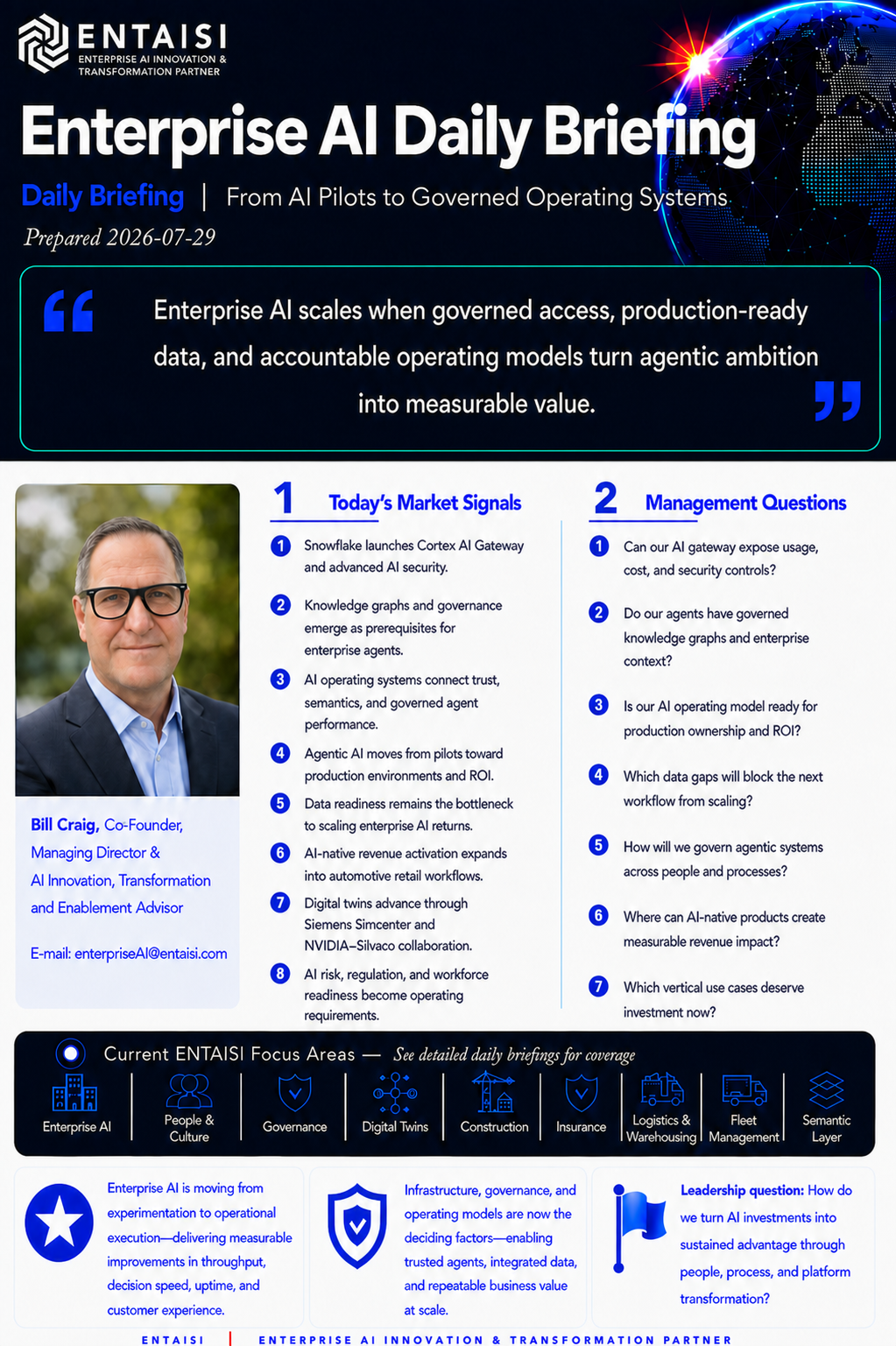
Today's scan shows enterprise AI becoming an operating discipline: governed access, production-ready data, semantic context, and accountable operating models are the conditions for moving from pilots to measurable value. Agentic platforms, AIOS patterns, native products, and vertical deployments all point to the same requirement—design the surrounding system, not only the model.
Across today's coverage, the differentiator is the operating environment around AI: knowledge graphs and governance for agents, secure gateways and AIOS layers for control, data readiness for scale, and domain workflows where outcomes can be measured.
Knowledge graphs, enterprise data, identity, and validation are moving from supporting capabilities to the runtime foundation for agents.
Trusted internal platforms and AI-native products can accelerate usage, but ROI depends on workflow redesign, data readiness, and visible operating metrics.
Digital twins, construction, insurance, logistics, and fleets show where domain context turns enterprise AI into accountable work.
SAP's agent-readiness model combines knowledge graphs, enterprise context, permissions, and validation; Cisco's Circuit shows how a trusted internal platform can turn secure access into broad adoption.
NiCE Labs is converting agentic research into customer-experience prototypes, showing how an applied lab can connect experimentation to workflow-level demonstrations.
The Redesign for enterprise AI story points leaders toward operating-model change: redesign value streams, ownership, governance, and measures around how AI changes work.
The ROI coverage highlights a familiar gap: organizations can generate insights yet fail to capture savings when adoption, cost visibility, and value accountability are not designed together.
Alation's AIOS framing positions trust, semantics, data context, and governed agent performance as a connective operating layer for enterprise AI.
Leena AI illustrates automation moving from a focused HR chatbot toward an agentic enterprise model where assistants can coordinate work across business processes.
Dun & Bradstreet's survey signal is that returns are advancing, but data readiness remains scarce; scaling depends on closing the gap between enthusiasm and usable foundations.
Conversica's Ignite applies an AI-native revenue activation model to automotive retail, showing how domain products can be rebuilt around agent-led customer engagement.
The agentic-environment coverage emphasizes that production agents need a surrounding environment of data, controls, workflow integration, and accountable operating practices.
The maturity story shows why pilots stall: enterprise architecture, enablement, and solution design must carry successful experiments into repeatable production value.
The regulatory brief connects AI governance to policy, safety, compliance, and risk decisions that must be operationalized across jurisdictions and use cases.
EXL's recognition puts talent and culture in the implementation frame: attracting and retaining AI professionals is part of building durable enterprise capability.
Siemens Simcenter and the NVIDIA–Silvaco collaboration show digital twins advancing through faster, more capable engineering simulation for complex industrial and semiconductor workflows.
The Enterprise Knowledge Layer story reinforces that semantic structure is becoming a runtime dependency for agents that must understand enterprise meaning and relationships.
Construction coverage links AI to forecasting, safety, and jobsite execution—use cases where domain context and field accountability determine whether adoption creates operational value.
New insurance products for AI-caused damage signal a growing risk-transfer market as organizations confront liability and accountability for AI-enabled decisions.
Warehouse shuttle software coverage points to the role of AI and automation in scaling material movement, with market growth tied to increasingly intelligent warehouse operations.
Motive's Atlas shows fleet AI moving toward an assistant model that can reduce administrative work and help operators act on operational context inside fleet workflows.
Forecasting and safety coverage points to AI entering project controls and jobsite decisions, where connected field data and accountable execution matter.
AI-specific insurance products show the market beginning to price and transfer risk created by AI-enabled activity and decisions.
Warehouse shuttle software growth reflects the operational pull toward intelligent material movement and automation at scale.
Atlas brings conversational assistance into fleet workflows, with potential to reduce administrative drag while preserving operational control.
Simcenter and NVIDIA–Silvaco coverage show AI-enhanced simulation supporting faster engineering validation and semiconductor design decisions.
EXL's recognition reinforces that AI talent, employer capability, and culture are part of the production system required to sustain enterprise adoption.
This is adjacent/older coverage surfaced because the query returned no stronger result within the preferred 48–72-hour window. The headline reports Snowflake Launches Cortex AI Gateway and Advanced AI Security at Black Hat 2026. The available RSS record identifies the organization or publication named in the headline and places the item in the enterprise-AI context of this section.
The implementation signal is the specific product, program, operating model, or market development named in the headline: Snowflake Launches Cortex AI Gateway and Advanced AI Security at Black Hat 2026. Because the RSS item supplied a headline-level description rather than article text, technical details beyond that claim are not inferred here.
In context, the item is useful as a directional signal about how enterprise buyers are evaluating AI: through governance, deployment readiness, operating economics, or domain-specific execution rather than generic model novelty.
Why it matters: In Enterprise AI, “Snowflake Launches Cortex AI Gateway and Advanced AI Security at Black Hat 2026” links the reported headline claim to the implementation/context above; enterprise adopters should use it to sharpen the relevant decision on architecture, controls, workforce readiness, or measurable value rather than treating the announcement as proof of production impact.
This is adjacent/older coverage surfaced because the query returned no stronger result within the preferred 48–72-hour window. The headline reports Why SAP says enterprise AI agents need knowledge graphs and governance. The available RSS record identifies the organization or publication named in the headline and places the item in the enterprise-AI context of this section.
The implementation signal is the specific product, program, operating model, or market development named in the headline: Why SAP says enterprise AI agents need knowledge graphs and governance. Because the RSS item supplied a headline-level description rather than article text, technical details beyond that claim are not inferred here.
In context, the item is useful as a directional signal about how enterprise buyers are evaluating AI: through governance, deployment readiness, operating economics, or domain-specific execution rather than generic model novelty.
Why it matters: In Enterprise AI, “Why SAP says enterprise AI agents need knowledge graphs and governance” links the reported headline claim to the implementation/context above; enterprise adopters should use it to sharpen the relevant decision on architecture, controls, workforce readiness, or measurable value rather than treating the announcement as proof of production impact.
This is adjacent/older coverage surfaced because the query returned no stronger result within the preferred 48–72-hour window. The headline reports NiCE Labs Turns Agentic AI Research Into CX Prototypes. The available RSS record identifies the organization or publication named in the headline and places the item in the enterprise-AI context of this section.
The implementation signal is the specific product, program, operating model, or market development named in the headline: NiCE Labs Turns Agentic AI Research Into CX Prototypes. Because the RSS item supplied a headline-level description rather than article text, technical details beyond that claim are not inferred here.
In context, the item is useful as a directional signal about how enterprise buyers are evaluating AI: through governance, deployment readiness, operating economics, or domain-specific execution rather than generic model novelty.
Why it matters: In Enterprise AI Labs, “NiCE Labs Turns Agentic AI Research Into CX Prototypes” links the reported headline claim to the implementation/context above; enterprise adopters should use it to sharpen the relevant decision on architecture, controls, workforce readiness, or measurable value rather than treating the announcement as proof of production impact.
This is adjacent/older coverage surfaced because the query returned no stronger result within the preferred 48–72-hour window. The headline reports Redesign for enterprise AI. The available RSS record identifies the organization or publication named in the headline and places the item in the enterprise-AI context of this section.
The implementation signal is the specific product, program, operating model, or market development named in the headline: Redesign for enterprise AI. Because the RSS item supplied a headline-level description rather than article text, technical details beyond that claim are not inferred here.
In context, the item is useful as a directional signal about how enterprise buyers are evaluating AI: through governance, deployment readiness, operating economics, or domain-specific execution rather than generic model novelty.
Why it matters: In AI Operating Models, “Redesign for enterprise AI” links the reported headline claim to the implementation/context above; enterprise adopters should use it to sharpen the relevant decision on architecture, controls, workforce readiness, or measurable value rather than treating the announcement as proof of production impact.
This is adjacent/older coverage surfaced because the query returned no stronger result within the preferred 48–72-hour window. The headline reports Enterprise AI is generating business insights but not saving money, and the governance gap is widening. The available RSS record identifies the organization or publication named in the headline and places the item in the enterprise-AI context of this section.
The implementation signal is the specific product, program, operating model, or market development named in the headline: Enterprise AI is generating business insights but not saving money, and the governance gap is widening. Because the RSS item supplied a headline-level description rather than article text, technical details beyond that claim are not inferred here.
In context, the item is useful as a directional signal about how enterprise buyers are evaluating AI: through governance, deployment readiness, operating economics, or domain-specific execution rather than generic model novelty.
Why it matters: In Enterprise AI-ROI & Value Maximization, “Enterprise AI is generating business insights but not saving money, and the governance gap is widening” links the reported headline claim to the implementation/context above; enterprise adopters should use it to sharpen the relevant decision on architecture, controls, workforce readiness, or measurable value rather than treating the announcement as proof of production impact.
This is adjacent/older coverage surfaced because the query returned no stronger result within the preferred 48–72-hour window. The headline reports An Intelligence Operating System for Enterprise AI: Alation's AIOS. The available RSS record identifies the organization or publication named in the headline and places the item in the enterprise-AI context of this section.
The implementation signal is the specific product, program, operating model, or market development named in the headline: An Intelligence Operating System for Enterprise AI: Alation's AIOS. Because the RSS item supplied a headline-level description rather than article text, technical details beyond that claim are not inferred here.
In context, the item is useful as a directional signal about how enterprise buyers are evaluating AI: through governance, deployment readiness, operating economics, or domain-specific execution rather than generic model novelty.
Why it matters: In AI Operating Systems (AIOS), “An Intelligence Operating System for Enterprise AI: Alation's AIOS” links the reported headline claim to the implementation/context above; enterprise adopters should use it to sharpen the relevant decision on architecture, controls, workforce readiness, or measurable value rather than treating the announcement as proof of production impact.
This is adjacent/older coverage surfaced because the query returned no stronger result within the preferred 48–72-hour window. The headline reports Leena AI: From HR chatbot to the agentic enterprise. The available RSS record identifies the organization or publication named in the headline and places the item in the enterprise-AI context of this section.
The implementation signal is the specific product, program, operating model, or market development named in the headline: Leena AI: From HR chatbot to the agentic enterprise. Because the RSS item supplied a headline-level description rather than article text, technical details beyond that claim are not inferred here.
In context, the item is useful as a directional signal about how enterprise buyers are evaluating AI: through governance, deployment readiness, operating economics, or domain-specific execution rather than generic model novelty.
Why it matters: In AI Automation, “Leena AI: From HR chatbot to the agentic enterprise” links the reported headline claim to the implementation/context above; enterprise adopters should use it to sharpen the relevant decision on architecture, controls, workforce readiness, or measurable value rather than treating the announcement as proof of production impact.
This is adjacent/older coverage surfaced because the query returned no stronger result within the preferred 48–72-hour window. The headline reports Dun & Bradstreet's AI Momentum Survey of 10,000 Businesses Finds Enterprise AI Returns Continue to Advance, But Only 6% Have the Data Ready to Scale Them. The available RSS record identifies the organization or publication named in the headline and places the item in the enterprise-AI context of this section.
The implementation signal is the specific product, program, operating model, or market development named in the headline: Dun & Bradstreet's AI Momentum Survey of 10,000 Businesses Finds Enterprise AI Returns Continue to Advance, But Only 6% Have the Data Ready to Scale Them. Because the RSS item supplied a headline-level description rather than article text, technical details beyond that claim are not inferred here.
In context, the item is useful as a directional signal about how enterprise buyers are evaluating AI: through governance, deployment readiness, operating economics, or domain-specific execution rather than generic model novelty.
Why it matters: In AI adoption, “Dun & Bradstreet's AI Momentum Survey of 10,000 Businesses Finds Enterprise AI Returns Continue to Advance, But Only 6% Have the Data Ready to Scale Them” links the reported headline claim to the implementation/context above; enterprise adopters should use it to sharpen the relevant decision on architecture, controls, workforce readiness, or measurable value rather than treating the announcement as proof of production impact.
This is adjacent/older coverage surfaced because the query returned no stronger result within the preferred 48–72-hour window. The headline reports Conversica launches Ignite, an AI-native Revenue Activation Engine for automotive retail. The available RSS record identifies the organization or publication named in the headline and places the item in the enterprise-AI context of this section.
The implementation signal is the specific product, program, operating model, or market development named in the headline: Conversica launches Ignite, an AI-native Revenue Activation Engine for automotive retail. Because the RSS item supplied a headline-level description rather than article text, technical details beyond that claim are not inferred here.
In context, the item is useful as a directional signal about how enterprise buyers are evaluating AI: through governance, deployment readiness, operating economics, or domain-specific execution rather than generic model novelty.
Why it matters: In AI-enabled, AI-first, and AI-native product and operating model shifts, “Conversica launches Ignite, an AI-native Revenue Activation Engine for automotive retail” links the reported headline claim to the implementation/context above; enterprise adopters should use it to sharpen the relevant decision on architecture, controls, workforce readiness, or measurable value rather than treating the announcement as proof of production impact.
This is adjacent/older coverage surfaced because the query returned no stronger result within the preferred 48–72-hour window. The headline reports Building the enterprise environment for agentic AI. The available RSS record identifies the organization or publication named in the headline and places the item in the enterprise-AI context of this section.
The implementation signal is the specific product, program, operating model, or market development named in the headline: Building the enterprise environment for agentic AI. Because the RSS item supplied a headline-level description rather than article text, technical details beyond that claim are not inferred here.
In context, the item is useful as a directional signal about how enterprise buyers are evaluating AI: through governance, deployment readiness, operating economics, or domain-specific execution rather than generic model novelty.
Why it matters: In Agentic AI, “Building the enterprise environment for agentic AI” links the reported headline claim to the implementation/context above; enterprise adopters should use it to sharpen the relevant decision on architecture, controls, workforce readiness, or measurable value rather than treating the announcement as proof of production impact.
The headline reports Why Enterprise AI Maturity Stalls After Pilot Success. The available RSS record identifies the organization or publication named in the headline and places the item in the enterprise-AI context of this section.
The implementation signal is the specific product, program, operating model, or market development named in the headline: Why Enterprise AI Maturity Stalls After Pilot Success. Because the RSS item supplied a headline-level description rather than article text, technical details beyond that claim are not inferred here.
In context, the item is useful as a directional signal about how enterprise buyers are evaluating AI: through governance, deployment readiness, operating economics, or domain-specific execution rather than generic model novelty.
Why it matters: In AI Enablement, AI Solutions, AI Architecture, “Why Enterprise AI Maturity Stalls After Pilot Success” links the reported headline claim to the implementation/context above; enterprise adopters should use it to sharpen the relevant decision on architecture, controls, workforce readiness, or measurable value rather than treating the announcement as proof of production impact.
This is adjacent/older coverage surfaced because the query returned no stronger result within the preferred 48–72-hour window. The headline reports July 2026 Global Regulatory Brief: Stablecoins, AI governance and regulatory sandboxes. The available RSS record identifies the organization or publication named in the headline and places the item in the enterprise-AI context of this section.
The implementation signal is the specific product, program, operating model, or market development named in the headline: July 2026 Global Regulatory Brief: Stablecoins, AI governance and regulatory sandboxes. Because the RSS item supplied a headline-level description rather than article text, technical details beyond that claim are not inferred here.
In context, the item is useful as a directional signal about how enterprise buyers are evaluating AI: through governance, deployment readiness, operating economics, or domain-specific execution rather than generic model novelty.
Why it matters: In AI Governance, policy, safety, compliance, and AI Risk, “July 2026 Global Regulatory Brief: Stablecoins, AI governance and regulatory sandboxes” links the reported headline claim to the implementation/context above; enterprise adopters should use it to sharpen the relevant decision on architecture, controls, workforce readiness, or measurable value rather than treating the announcement as proof of production impact.
This is adjacent/older coverage surfaced because the query returned no stronger result within the preferred 48–72-hour window. The headline reports EXL Certified as a Best Firm for AI Professionals. The available RSS record identifies the organization or publication named in the headline and places the item in the enterprise-AI context of this section.
The implementation signal is the specific product, program, operating model, or market development named in the headline: EXL Certified as a Best Firm for AI Professionals. Because the RSS item supplied a headline-level description rather than article text, technical details beyond that claim are not inferred here.
In context, the item is useful as a directional signal about how enterprise buyers are evaluating AI: through governance, deployment readiness, operating economics, or domain-specific execution rather than generic model novelty.
Why it matters: In Enterprise AI People and Culture, “EXL Certified as a Best Firm for AI Professionals” links the reported headline claim to the implementation/context above; enterprise adopters should use it to sharpen the relevant decision on architecture, controls, workforce readiness, or measurable value rather than treating the announcement as proof of production impact.
This is adjacent/older coverage surfaced because the query returned no stronger result within the preferred 48–72-hour window. The headline reports Siemens today announced availability of the latest Simcenter. The available RSS record identifies the organization or publication named in the headline and places the item in the enterprise-AI context of this section.
The implementation signal is the specific product, program, operating model, or market development named in the headline: Siemens today announced availability of the latest Simcenter. Because the RSS item supplied a headline-level description rather than article text, technical details beyond that claim are not inferred here.
In context, the item is useful as a directional signal about how enterprise buyers are evaluating AI: through governance, deployment readiness, operating economics, or domain-specific execution rather than generic model novelty.
Why it matters: In Digital twins and industrial simulation, “Siemens today announced availability of the latest Simcenter” links the reported headline claim to the implementation/context above; enterprise adopters should use it to sharpen the relevant decision on architecture, controls, workforce readiness, or measurable value rather than treating the announcement as proof of production impact.
This is adjacent/older coverage surfaced because the query returned no stronger result within the preferred 48–72-hour window. The headline reports Silvaco Announces Collaboration with NVIDIA to Advance AI-Powered Semiconductor Digital Twins. The available RSS record identifies the organization or publication named in the headline and places the item in the enterprise-AI context of this section.
The implementation signal is the specific product, program, operating model, or market development named in the headline: Silvaco Announces Collaboration with NVIDIA to Advance AI-Powered Semiconductor Digital Twins. Because the RSS item supplied a headline-level description rather than article text, technical details beyond that claim are not inferred here.
In context, the item is useful as a directional signal about how enterprise buyers are evaluating AI: through governance, deployment readiness, operating economics, or domain-specific execution rather than generic model novelty.
Why it matters: In Digital twins and industrial simulation, “Silvaco Announces Collaboration with NVIDIA to Advance AI-Powered Semiconductor Digital Twins” links the reported headline claim to the implementation/context above; enterprise adopters should use it to sharpen the relevant decision on architecture, controls, workforce readiness, or measurable value rather than treating the announcement as proof of production impact.
This is adjacent/older coverage surfaced because the query returned no stronger result within the preferred 48–72-hour window. The headline reports The Enterprise Knowledge Layer. The available RSS record identifies the organization or publication named in the headline and places the item in the enterprise-AI context of this section.
The implementation signal is the specific product, program, operating model, or market development named in the headline: The Enterprise Knowledge Layer. Because the RSS item supplied a headline-level description rather than article text, technical details beyond that claim are not inferred here.
In context, the item is useful as a directional signal about how enterprise buyers are evaluating AI: through governance, deployment readiness, operating economics, or domain-specific execution rather than generic model novelty.
Why it matters: In Ontology, knowledge graph, and semantic layer developments, “The Enterprise Knowledge Layer” links the reported headline claim to the implementation/context above; enterprise adopters should use it to sharpen the relevant decision on architecture, controls, workforce readiness, or measurable value rather than treating the announcement as proof of production impact.
This is adjacent/older coverage surfaced because the query returned no stronger result within the preferred 48–72-hour window. The headline reports Better Forecasts, Safer Jobsites: AI's Growing Role in Construction. The available RSS record identifies the organization or publication named in the headline and places the item in the enterprise-AI context of this section.
The implementation signal is the specific product, program, operating model, or market development named in the headline: Better Forecasts, Safer Jobsites: AI's Growing Role in Construction. Because the RSS item supplied a headline-level description rather than article text, technical details beyond that claim are not inferred here.
In context, the item is useful as a directional signal about how enterprise buyers are evaluating AI: through governance, deployment readiness, operating economics, or domain-specific execution rather than generic model novelty.
Why it matters: In AI in Construction, “Better Forecasts, Safer Jobsites: AI's Growing Role in Construction” links the reported headline claim to the implementation/context above; enterprise adopters should use it to sharpen the relevant decision on architecture, controls, workforce readiness, or measurable value rather than treating the announcement as proof of production impact.
This is adjacent/older coverage surfaced because the query returned no stronger result within the preferred 48–72-hour window. The headline reports New insurance products cover damages caused by AI. The available RSS record identifies the organization or publication named in the headline and places the item in the enterprise-AI context of this section.
The implementation signal is the specific product, program, operating model, or market development named in the headline: New insurance products cover damages caused by AI. Because the RSS item supplied a headline-level description rather than article text, technical details beyond that claim are not inferred here.
In context, the item is useful as a directional signal about how enterprise buyers are evaluating AI: through governance, deployment readiness, operating economics, or domain-specific execution rather than generic model novelty.
Why it matters: In AI in Insurance, “New insurance products cover damages caused by AI” links the reported headline claim to the implementation/context above; enterprise adopters should use it to sharpen the relevant decision on architecture, controls, workforce readiness, or measurable value rather than treating the announcement as proof of production impact.
This is adjacent/older coverage surfaced because the query returned no stronger result within the preferred 48–72-hour window. The headline reports Warehouse Shuttle Software Market to Reach $2.66 Billion by 2030 as AI and Automation Transform Logistics. The available RSS record identifies the organization or publication named in the headline and places the item in the enterprise-AI context of this section.
The implementation signal is the specific product, program, operating model, or market development named in the headline: Warehouse Shuttle Software Market to Reach $2.66 Billion by 2030 as AI and Automation Transform Logistics. Because the RSS item supplied a headline-level description rather than article text, technical details beyond that claim are not inferred here.
In context, the item is useful as a directional signal about how enterprise buyers are evaluating AI: through governance, deployment readiness, operating economics, or domain-specific execution rather than generic model novelty.
Why it matters: In AI in Logistics & Warehousing, “Warehouse Shuttle Software Market to Reach $2.66 Billion by 2030 as AI and Automation Transform Logistics” links the reported headline claim to the implementation/context above; enterprise adopters should use it to sharpen the relevant decision on architecture, controls, workforce readiness, or measurable value rather than treating the announcement as proof of production impact.
This is adjacent/older coverage surfaced because the query returned no stronger result within the preferred 48–72-hour window. The headline reports Meet Atlas: Motive's AI Assistant for Fleets. The available RSS record identifies the organization or publication named in the headline and places the item in the enterprise-AI context of this section.
The implementation signal is the specific product, program, operating model, or market development named in the headline: Meet Atlas: Motive's AI Assistant for Fleets. Because the RSS item supplied a headline-level description rather than article text, technical details beyond that claim are not inferred here.
In context, the item is useful as a directional signal about how enterprise buyers are evaluating AI: through governance, deployment readiness, operating economics, or domain-specific execution rather than generic model novelty.
Why it matters: In AI in Fleet Management, “Meet Atlas: Motive's AI Assistant for Fleets” links the reported headline claim to the implementation/context above; enterprise adopters should use it to sharpen the relevant decision on architecture, controls, workforce readiness, or measurable value rather than treating the announcement as proof of production impact.
The July 29 scan points to enterprise AI becoming an operating discipline: governed access, production-grade data, semantic context, measurable value, and clear ownership are the foundation for agentic scale. The near-term leadership test is whether each priority workflow has the controls, data, people, and metrics needed to move from demonstration to durable business performance.