An AI assistant, an agent harness and an enterprise platform can all appear in the same buying conversation. That does not make them interchangeable. A useful comparison starts with the responsibility you need the technology to carry, not the number of logos on a landscape slide.
The October 2026 landscape supplied with this article separates four categories. Its most useful idea is that those categories overlap: a managed agent can contain a harness, while a platform can host both. Treat the picture as an orientation map, not a measured ranking or an independently verified product shortlist.
Four categories, four buying questions
The following are conceptual working definitions, adapted from the supplied “Harnesses & Platforms” source and its linked narrative. They are not universal industry standards or guarantees about every product in a category.
Conversational AI assistants: The primary interaction is a conversation: ask, explain, draft, analyse or explore. Some assistants also use tools and retain selected context. The buying question is: what help can a person obtain in the flow of their work, with which information and controls?
Self-hosted and developer agent harnesses: A harness surrounds a model with mechanisms for doing work: instructions, tool access, execution state and, depending on implementation, memory and orchestration. The buying question is: what execution environment must we configure and operate? Self-hosting the harness does not necessarily mean hosting the model; calls to an external model service may still be involved.
Managed autonomous agent products: The provider operates an environment in which a user can delegate multi-step work. Persistence, integrations and approval behaviour depend on the actual offering. The buying question is: what can we delegate, and what remains our responsibility? “Autonomous” is not permission to act without limits.
Enterprise AI development platforms: These provide environments for building, integrating, deploying and managing AI solutions across an organisation. The buying question is: which shared capabilities do our teams need, and how will we operate them? A platform label alone does not establish that its controls meet a particular requirement.
Read the landscape without turning it into a league table
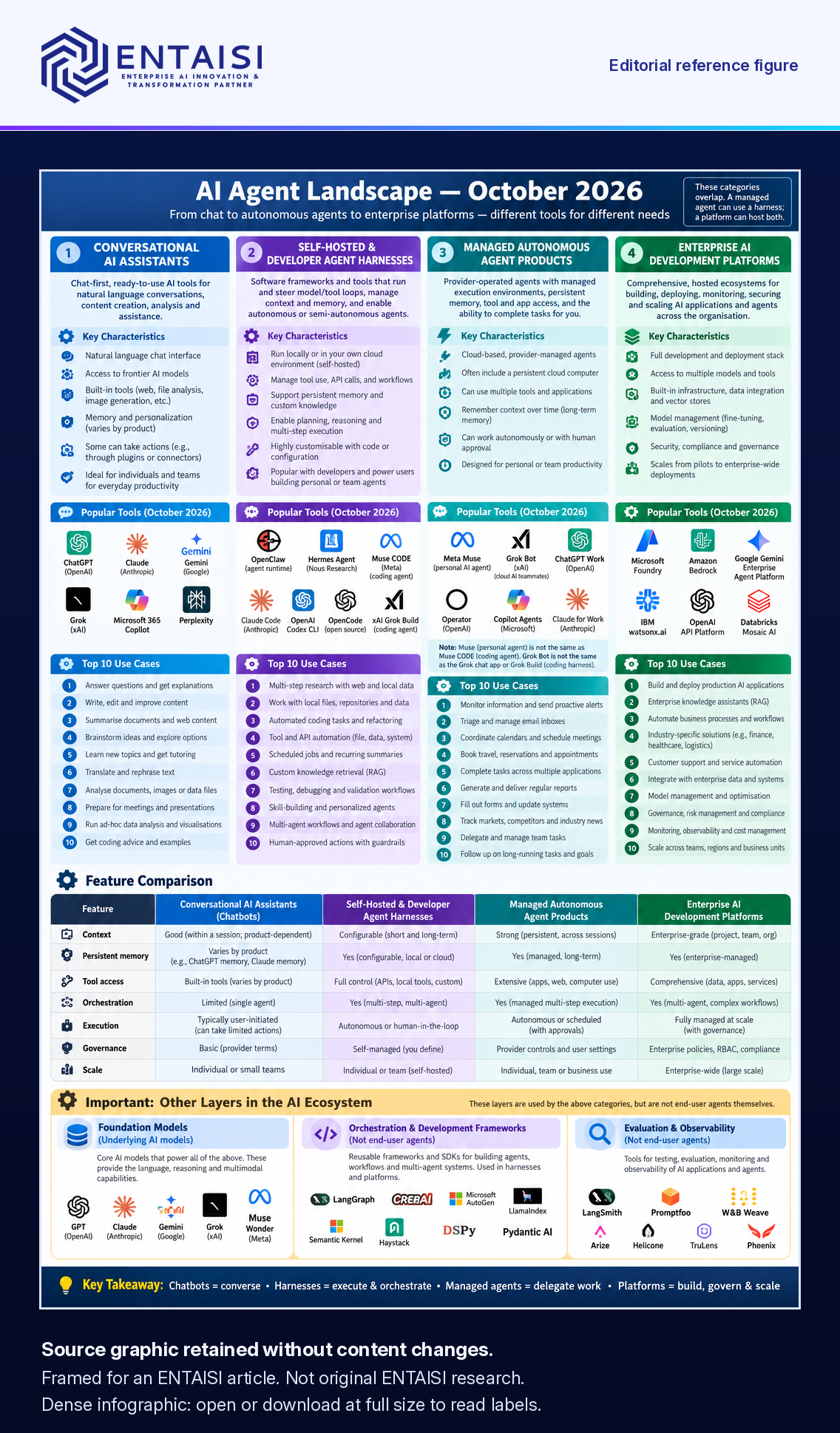
Text explanation of the landscape
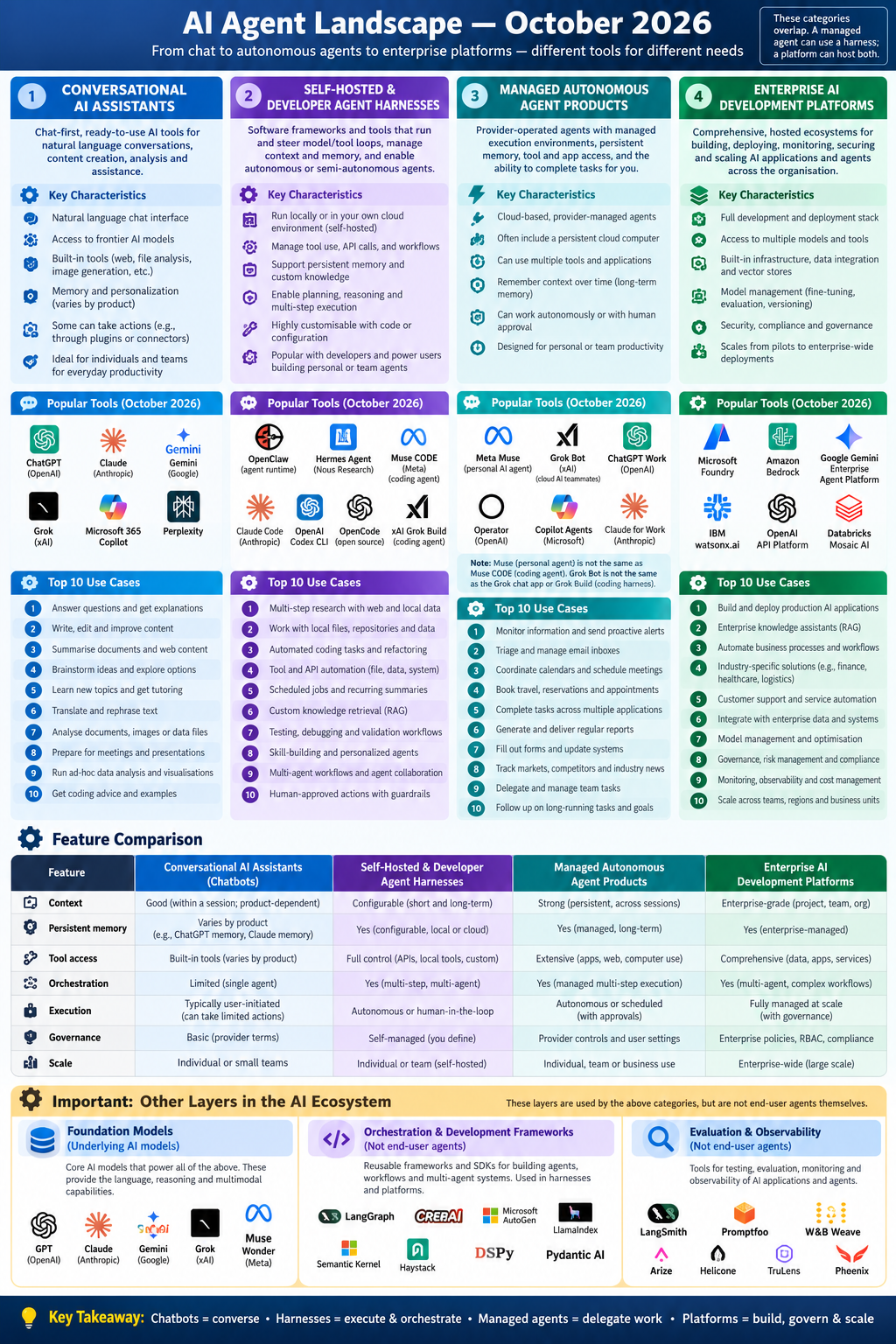
The four categories describe conversational interaction; configurable agent execution; provider-managed delegated work; and shared enterprise development and operations. Categories overlap rather than form a ladder. Each column contains example products, characteristics and suggested uses. A table compares context, persistent memory, tool access, orchestration, execution, governance and scale. Separate supporting layers identify foundation models, orchestration and development frameworks, and evaluation and observability tools. The article explains the conceptual distinctions; it does not endorse or independently verify the vendor entries or capability claims in the image.
The image’s four columns compare interaction, context, persistent memory, tool access, orchestration, execution, governance and scale. Below them, it separates foundation models, orchestration and development frameworks, and evaluation and observability tools from the four main categories.
Those supporting layers matter. A model is not a complete operating environment. A development framework is not automatically a finished business application. An evaluation tool helps examine behaviour; it does not, by itself, supply the agent or establish that the system is safe.
The vendor examples and use-case lists in the supplied October snapshot are not an ENTAISI endorsement, current availability confirmation or evidence of results. Product boundaries can overlap, and the same vendor can offer different experiences. Check the exact product, plan, deployment and configuration rather than assigning capabilities from the column heading.
A harness runs the work; a platform supports the estate
For a buyer, the practical distinction is scope. A harness focuses on how an agent proceeds: which context it receives, which tool it calls, how it records progress and when it stops or asks for help. A platform may supply shared services for multiple applications, teams and environments, including identity, integration, deployment and monitoring.
These are not opposing purchases. A team may use a harness inside a platform, or use a managed product whose underlying harness it never operates directly. Conversely, buying a platform does not remove the need to define how an individual agent behaves.
Ask suppliers to draw the boundary. Which components do they operate? Which must your team build, configure, secure or maintain? Where does information leave your environment? What changes when a model, connector or product version changes? A clear answer is more useful than an expansive category label.
Compare one task across the options
Consider a supplier-review brief—an illustrative example, not a client case. A buyer wants a summary of approved supplier documents, missing information and questions for a reviewer.
A conversational assistant might help a person analyse the supplied documents. A harness-based implementation might retrieve approved files, apply a repeatable sequence and assemble a draft. A managed agent might undertake that delegated task within its supported environment. A platform might provide the shared identity, retrieval, deployment and logging services behind the application.
These are possible design choices, not claims that every product can perform the task. Start with the same sample documents and expected output for each candidate. Ask the supplier to demonstrate what happens when a document is missing, sources disagree or an integration fails. Keep supplier approval and any external communication outside the task unless separately authorised.
Five questions before the shortlist
The following is ENTAISI buyer guidance, not a finding measured by the landscape:
- Execution: What can the system actually do, and which actions are unavailable or require approval? Distinguish preparing a change from committing it.
- Context and memory: What is retained, for how long and for whom? Can the organisation inspect, correct, export and delete it? Do not assume remembered information is current or authorised for every task.
- Operating responsibility: Who handles updates, failed integrations, support and incident response? Include your own engineering and administrative work when comparing options.
- Control and evidence: Can the supplier demonstrate identity boundaries, permissions, logs and escalation for your scenario? Ask for evidence from the proposed configuration, not only a feature list.
- Commercial fit and exit: What drives charges, what usage limits apply, and what can you take with you if you leave? Compare the complete proposed service, including review and maintenance, rather than a model price alone.
Choose the missing layer, not the biggest label
An organisation that needs better drafting may not need a new agent runtime. A team building a specialised tool-enabled application may need execution control more than another chat interface. Multiple teams sharing integrations and operational requirements may need platform capabilities—but should still identify the specific gap.
Use the landscape to ask better questions, then replace category assumptions with demonstrations, documentation and contract terms. The right shortlist is the one whose responsibilities match the work you intend to delegate and the work your organisation is prepared to own.
Source and image note: Adapted from the supplied October 2026 “Harnesses & Platforms” material. The taxonomy is conceptual, not a benchmark. Product examples within the artwork have not been independently verified for this article. The landscape is a supplied third-party graphic; its original creator and reuse licence have not been confirmed. ENTAISI styling does not imply authorship of the underlying landscape, endorsement of its examples, or ownership of third-party marks.